Chapter 24: The Dark Empath
Act III: Life Unraveling… · The Null Identity, serialized.
Rock Bottom
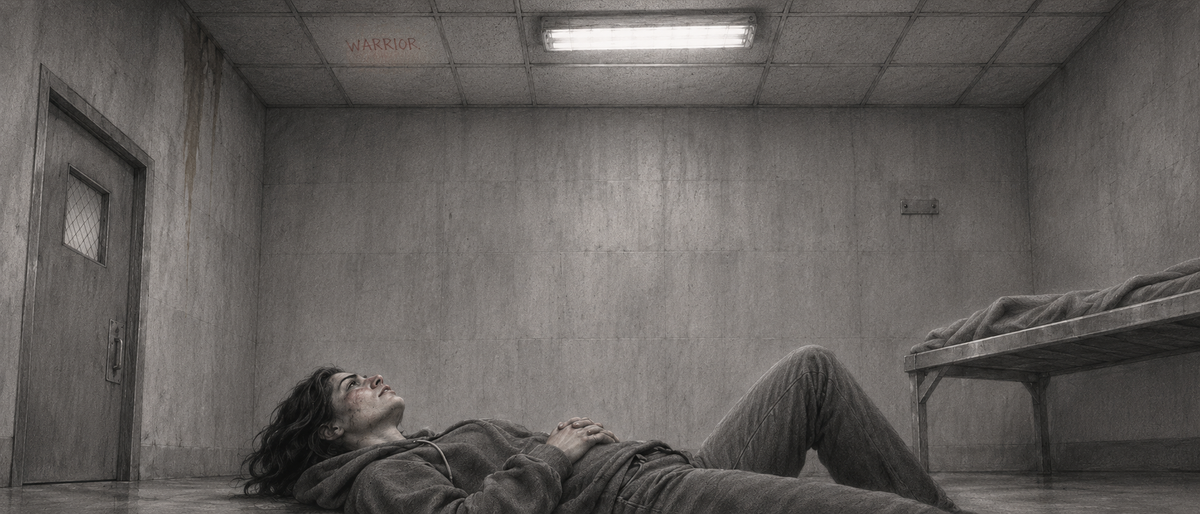
The cot was worse than the floor. The cot smelled. She had tried it for ten minutes after they put her in the cell, and then she had come down to the concrete and stayed there. The concrete was cold. The cold was honest. The cot was something other people had been on, and what they had brought to it was still in the mattress.
She had not slept. She had lain on her back with her hands folded over her stomach and looked up.
The ceiling above her was acoustic tile in a metal grid, water-stained in the corner near the doorframe, a bracket where something used to be. She had never been in a jail cell. The movies had been correct about the portrayal.
She did not pray. She had prayed at seven. She had prayed at eleven. She had prayed once at sixteen for a thing she could no longer remember the contents of, and once at twenty-six for her mother, who had not been findable then either. The prayers had gone where prayers went. She had stopped praying not in rejection but in honesty. She was a person whose questions did not match the answers she had been offered. She did not begrudge the answers. She did not need them.
She looked at the ceiling. She asked the ceiling anyway.
Is there a god.
The ceiling did not answer.
She traced the seam between two tiles. She traced a water stain. She traced the bracket. Her eyes moved without intention along the surface of the only thing in the room she could see that had not been touched by anyone in it, and her eyes caught.
A word. Above the second tile from the door. Hand-inked. Red. Faded. Block letters. The letters of someone who had had something to write with and nothing to write on.
WARRIOR
She held still.
She was seven. She was on a trail. The redwoods went up forever and the light came down through them in long columns. Her father had his hands on the sides of her face. His hands were rough and warm. They smelled like bar soap and coffee.
Warriors are careful. Warriors don’t run ahead of their people.
She was thirty-two. She was on the concrete floor of a King County holding cell. The word her father had given her was on the ceiling.
Somebody had lain on this floor before her and looked at this ceiling and made the word above where no guard would see it. A person had been here who had been a warrior and had wanted the next person who was a warrior to know that warriors had been here too.
Or a god. Either was an answer. She did not need to choose between them.
She closed her eyes.
She thought, I am still here, Daddy.
She thought, Whoever you were, thank you.
She did not cry. She had not cried since the patrol car. She did not have crying for this. She had the word, and the cold floor, and the hours she still had to wait in the room with the buzzing light, and the recognition that the ceiling had answered after all.
Down the corridor the woman who had been sobbing earlier was quiet now. Two cells over a man snored through a sinus condition. A radio crackled at the guard station. The ventilation hummed.
She breathed.
She held the word.
Bail
The lock turned at ten past nine. She did not move. The voice that came through the door was the voice of a man who had said the same sentence many times that week.
“D’Sylva. Up. You made bail.”
She got up.
Her muscles had locked from the floor. She let them unlock against the wall and then she walked across the cell and out into the corridor, and the guard did not touch her, because she was not the kind of person they had to touch.
They walked her down to processing.
The processing area was a counter, a chair bolted to the floor, a light panel, a poster about the Identified Displaced Individuals program in three colors. The clerk behind the counter was a woman whose name plate said MARTHA. Martha appeared to be in her sixties. Martha had been doing this since before this had a name.
Martha looked at her.
Martha said, “Sit.”
She sat.
Martha typed. The keys clicked. Martha pulled a folder. Martha laid out two pamphlets and a green-bordered card on the counter.
“Temporary identification,” Martha said. “Issued by the county. Good for ninety days. The card scans for purposes the federal system can’t help you with. Local bus. Public library. Some clinics. Some grocers.”
She did not look at the card.
“Pamphlet one is your IDI orientation packet. There’s a number on the back. You call it within seventy-two hours or your provisional status lapses. Pamphlet two is the FEMA temporary federal housing intake. You can walk in or call. They will take you the same day.”
She did not look at the pamphlets.
“Sign here.”
She did not sign.
Behind her, the door of the lobby clicked. She heard a step. She heard the quality of breath that came when a person was about to make a particular kind of statement on her behalf.
“She won’t be needing that.”
Martha looked up. Martha did not look surprised. Martha had seen, by ten past nine on a weekday morning, several things that would have surprised other people. Martha closed the folder and slid the pamphlets and the green card to one side of the counter.
“Whatever you say.”
Dani did not turn around. She did not need to see Max to know what kind of standing he had managed. Posted bail at this hour, with a county clerk willing to slide the IDI packet aside on his word, that was the kind of money he had told her about three nights ago in the loft. He had said I am living on this too. He had said eight years. He had said you don’t last in this work without a way out. He was using the way out now.
Martha pushed a release form across the counter and a pen on top of it.
“Sign here, please, ma’am.”
She signed.
Martha gave her a manila envelope of her belongings (her burner phone, her wallet, her keys) and Martha said, “Good luck,” in the voice of a person who said it twenty times a day. She did not say good luck the way the man with the reading glasses at the corner store had said it three nights ago. She said it the way the form required.
She put the envelope into her hoodie pocket. She stood up. She turned.
Max was at the door.
He had not slept. The skin under his eyes was the color of new bruise. He had on the charcoal coat and an old Henley that had been gray once. He had not shaved. He held a paper cup of coffee in one hand and another paper cup in the other.
He saw her see him.
He did not smile. He did not move toward her. He held the second cup out at a distance that did not require her to come close to take it.
She did not take it.
He set both cups on the counter beside Martha’s elbow.
“Let’s go,” he said.
She walked past him.
He followed.
The lobby door opened onto a small concrete lot with a flagpole and four cars and an Uber at the curb with its hazards on. The driver was looking at his phone. The morning was the kind of Seattle morning that had decided to be sunny, the sky had cleared overnight and the light coming off the wet pavement was brighter than her eyes were prepared for.
She squinted.
She did not say thank you.
She walked to the curb. She opened the back door of the Uber and got in.
Max got in on the other side.
The driver looked up. “Du Bois?” The driver pronounced it the way Max would have pronounced it. The way Max had pronounced it on the app.
“Yes,” Max said.
“Going to —” the driver checked his screen — “Capitol Hill?”
“Yes.”
The driver pulled out.
She looked out her window.
She did not look at Max.
The car turned out of the lot and onto James and went up the hill toward First Hill and then crossed Broadway. She watched her city through the window. The city looked like her city. Coffee shops opening. A bus pulling away from a stop. A woman walking a dog. The architecture that had made her a Zero was running in the buildings under all of it, and the city looked exactly the same.
Max did not speak.
She did not speak.
The driver had the radio on low. A morning show. Two voices laughing about something she did not hear.
She did not look at Max once between the jail lot and her own block. She watched her city. She catalogued.
The light is the light I remember. The buses run on the schedule they ran on. The coffee shops have the same names. Nothing is different. I am different. The country I am in now sits underneath the country I lived in. I am the only one in this car who knows that. The driver does not know. Max knows.
The cadence she did not look up from kept going.
He noted me. He filed me. He is here. He paid for the car. He has not asked me anything. He will not ask me anything.
The car turned onto Tenth.
Three blocks.
She breathed.
What Survived
The Uber pulled up in front of her house and the driver said, “Here you are,” and Max said, “Thank you,” and Max paid through the app and the car pulled away.
She stood on the sidewalk.
Mrs. Chen was on her porch across the street. She had a broom in her hand and she was not sweeping. She lifted a hand. The hand was not a wave. The hand was a recognition.
Dani lifted a hand back.
Mrs. Chen went inside.
The two young men in the duplex across the street were not on their porch this morning. The patrol car had not come back. Yellow tape was strung across her doorframe, not crime-scene tape. A different yellow. POLICE INVESTIGATION DO NOT ENTER printed on it, the kind of tape that meant nothing legally on the third day. It was already dirty.
The door was on the porch. They had not put it back. It was propped against the porch railing, splintered along the strike plate, the deadbolt still in the wood. Someone, Mrs. Chen probably, had pulled it from where it had fallen and stood it up out of the rain.
The frame was open onto her living room.
She ducked under the tape. She did not need to break it. She had not been told she could not enter. She had been told she was not the resident of record. The writ had been served. They had taken what they had come for.
The cold came out of the doorway to meet her.
She walked inside.
Her father’s tent in the living room had been kicked over. The nylon was torn along one seam. The propane stove had been dragged out of place and the small camp lantern had been opened, its battery compartment exposed, the batteries on the floor. The work laptop was gone. The papers she had stacked on the kitchen counter were gone. The drawers in the kitchen were open.
She did not look at any of it for long.
She walked to the mantel.
The vase was where it had been. White ceramic. Hand-painted flowers. Cairo, 1998. Her mother’s two hands had carried it back from a market on the only trip her parents had ever taken outside North America. The vase sat on the mantel where her mother had set it once and never moved it.
The vase had not been touched.
She reached up and took it down. It was lighter than its size suggested. She tilted it and reached two fingers inside. The paper towel had not moved. She pulled it out and unfolded it.
The USB drive.
She held it.
She put the paper towel back into the vase. She set the vase back on the mantel exactly where it had been. The dust around its base had not been disturbed. The dust around its base was still not disturbed.
She put the USB drive in the inside pocket of her hoodie.
Max stood at the splintered jamb. He had not come in. He was looking at the room. He was not looking at the vase. He was not looking at her hand or her pocket. He was, deliberately, not looking at any of it.
That was a kindness she did not have to thank him for.
She walked around the house. She did not pick anything up. The books had been pulled off the shelves. Her clothes had been pulled out of drawers. The framed photo of her with her mother had been knocked off the wall, glass cracked. She picked the photo off the floor. She walked it into her bedroom and laid it on her bed. The bed had been pulled apart, the mattress half off the box spring. She straightened the mattress enough to lay the photo flat.
She went back into the kitchen.
The fridge was open. The smell was noticeable. The food in it needed to be thrown out.
She closed the fridge.
She stood in her own ransacked kitchen and she looked through the doorway into her own ransacked living room.
She turned.
Max was still at the doorframe.
She looked at him.
She said the sentence.
“The failure is the design.”
She had not rehearsed it. She had not known she was going to say it until she heard her own voice say it in her own kitchen. The sentence came up out of her without any of the slow recognition she had thought it would have. The sentence had been ready.
Max looked at her.
He did not move.
His face did the thing she had watched it do once before, in the loft three nights ago when she had said you’re not lasting. The thing his face did was the moment of confirmation a person gave when they had heard a sentence that took the floor out from under them and they were not going to be allowed to fall.
He nodded once.
“Yes,” he said.
He said it quietly. He said it the way a man said yes in a doctor’s office to a question that closed something.
He looked away from her.
He did not say anything else.
She stood in her kitchen and let the silence be the rest of the conversation.
After a long time, in a voice that was not the voice he had used to confirm (a voice that was operational, lower, working) he said, “You can’t sleep here. There’s no power. The door’s gone.”
She did not answer.
“My place,” he said. “You’ll have the bedroom.”
She looked at the doorway behind him. She looked at her ransacked living room. She looked at the vase on the mantel.
She thought about the woman with the thermos at the median strip on Twelfth. She thought about Sarah Torres saying don’t come here, Dani. She thought about her own bedroom upstairs that she would not be sleeping in tonight either way, because the heat had not come back on and would not be coming back on, and because she did not yet know if the people who had taken the laptop knew that she had run Prometheus before they had gotten to her.
I have what I came for.
She walked past him through the doorframe and onto her porch.
She did not look back.
He followed her.
He pulled the broken door across the doorframe as he came out so the opening looked closed. He did not say anything about doing it. He did not ask her to thank him. He did not look at her face. He pulled the door across and he turned and he walked down the porch steps behind her to the curb, and he opened the Uber app on his phone, and they stood on the sidewalk in the morning light and waited.
She did not speak.
He did not speak.
The car came in seven minutes.
The Glow
His loft was eight blocks. The Uber went up Pike and over to Twelfth and turned north and stopped at the awning of his building. Max paid. They got out.
The freight elevator made the sound it always made. The hallway smelled the way it always smelled, rubber matting and the dry cleaner three doors down. Max unlocked the door. He held it open for her.
She walked past him into the loft.
The loft looked the way it had looked. The desk with the four monitors. The whiteboard with diagrams she could no longer pretend not to understand. The kitchen at the far end. The couch they had made love on.
A second monitor she did not remember had been added to the desk. A scanner. A small printer. A row of external drives. A stack of paper, printouts organized in some order, beside the keyboard. He had not been idle since she had walked out.
He closed the door behind her.
He hung up his coat.
“You should eat,” he said.
“I’m not hungry.”
“You should eat anyway.”
She did not answer. He went into the kitchen. She heard him open the fridge. She heard him put a pan on the stove. She heard him do the things he had done a hundred times.
She stood in the middle of the loft.
She had been in this room a month ago in a different life. She had been in this room three nights ago in this one. She did not know what life she was in now. The room had not chosen.
Dani’s eyes narrowed. “Do I call you Max, or Janus?”
Max winced. “It’s not… it’s not that simple,” he said, his voice low. “I wasn’t always like this.”
He paused, his gaze drifting to the window, where the city lights twinkled in the twilight. “Before I met you, I was involved in… some things I’m not proud of. I made some bad choices, got mixed up with the wrong people.”
He turned back to her, his eyes pleading for understanding. “But that’s not who I am now. I’m trying to make things right. I’m trying to get out.”
Dani’s expression softened slightly, a flicker of empathy crossing her face. Max noticed the shift, a small victory in his carefully crafted narrative.
“They zeroed me out too, Dani,” he continued, his voice laced with a hint of vulnerability. “I lost everything. My accounts, my identity, my place in the world. I’m just as much a victim as you are.”
He brought her a bowl. It was warm. It had rice and beans and a fried egg and something green. She did not look at it long enough to identify the green.
She ate it.
She was not hungry. Her body ate anyway. She had not eaten properly in three days.
He did not sit with her. He set his own bowl on the desk and he sat in front of the monitors and he began to work.
She watched him eat with one hand and type with the other.
She watched.
After a while she said, “You said the bedroom.”
“Yes.”
She walked into the bedroom.
The bed was made. He had made it that morning, or yesterday morning, or some morning she did not know. The sheets were the sheets she had slept on. The window was the window she had looked out of. The closet was the closet a shirt of his had hung on the back of the door of.
She closed the door behind her.
She sat on the edge of the bed.
She could lie down. She could put her head where her head had been on a morning a week ago when she had woken in this bed thinking she had everything she wanted. The pillow remembered her. Her body remembered.
She let herself want it for a held breath.
I want him to be what I thought he was.
I want to be the woman who walked in here a week ago and did not yet know.
Then she did not.
She did not because on the other side of the door was a man doing something to her that she had not seen him do. He was working. He was, by his own account, working on her. The scanner and the printer and the row of external drives that had not been on the desk three nights ago were doing something at three in the morning to records she could not yet read.
She did not know what kind of work it was.
She did not know if he was fixing her.
She did not know if he was fixing himself through her.
The bed could not answer. The bed was not in the room with him.
She got up.
She opened the door.
She walked back out into the loft.
She did not say anything. She walked to the couch. She lay down on her side facing the desk. She pulled the throw off the back of the couch and put it over her shoulders.
The bed was softer.
The couch could see him.
Max did not look up.
He kept typing.
After a while he said, without turning, “It’s an entropy starvation flaw.”
She did not move.
“The Identity Layer,” he said. “The federal one. It generates UUIDs from a kernel pool that was sized for a load profile that no longer exists. Under enough simultaneous load, the pool runs out. An authenticated operator with the right permission can, under the right call pattern, cause the system to return a null UUID instead of failing. The system thinks it has returned a real value. Downstream services think the record doesn’t exist. The record is fine. The connection between the record and the system is the part that breaks.”
She watched him type.
“They didn’t build the vulnerability,” he said. “It’s a real flaw. CVE-2025-66630. The researcher who found it published last February. Three years after Pavel’s people had already been using it.”
She heard him.
“They didn’t have to build anything. They learned how to make the system forget.”
She heard him.
She was tired. She had not slept in the cell. She had not slept on her own couch the night before that. She had not slept properly since the SSA office. The food was warm in her body and the throw was warm over her shoulders and the monitors made a sound that was almost not a sound, and the keys clicked, and Max’s voice was low and even, and his back was the back she had laid her cheek against once in this room and would not lay her cheek against again.
He said something else. Something about the null UUID. Something about how the response signature was indistinguishable from a legitimate non-existent record. She caught the shape of it. She did not catch the details. She would, later. The pieces were already filing into the place she would file them.
He said, “The architecture is older than the network that’s using it.”
She caught that one.
He said, “The fence was built before the people who built the fence existed.”
She caught that one.
He said, “Whoever designed it wasn’t Pavel. Pavel found it.”
She caught that one.
She watched him work.
The monitors lit the side of his face. His profile was the profile she had known. He was bent forward toward the screens. His hands moved across the keys.
He was being useful.
He had been useful to her in the café in Seattle. He had been useful to her in the bookshop. He had been useful to her at the food cart, at the gallery, at the rooftop bar where he had asked her what she wanted in a life and had listened to her answer with the attention of a man who had not yet decided whether to use it. He had been useful to her three nights ago in this loft when he had pulled twenty bands of hundreds out of a metal case behind a hardcover book and given them to her and said you don’t last in this work without a way out.
He was useful now.
He was useful at three in the morning at his desk in his loft to the woman whose architecture he had been part of designing the conditions for.
He was useful in the same exact way he had always been useful.
The dark empath.
The recognition arrived gently. It arrived in the moment her body was already going. She did not have the energy to push back against it. She let it through.
He is a dark empath, she thought. He always was.
She closed her eyes.
Max kept typing.
She heard him say, far away, “Sleep, Dani.”
She slept.
Before He Wakes
She woke at five.
The blue of the monitors was the only light. The sky outside the loft window was the gray that came before light. She did not move at first. She let her body register the room.
Max was asleep at the desk.
He had laid his head down on his arms. The screens above him still glowed. The chair was the chair he had been sitting in when she had gone to sleep. He had not moved to the bedroom. He had not stretched out on the couch. He had put his head down on his arms when his body had told him to and had not gotten up since.
She watched the rise and fall of his back.
She sat up.
The throw fell off her shoulders. The room was cold the way rooms got before the radiator decided to come on. The pipes were ticking somewhere in the wall.
She put on her boots. She had been wearing the same clothes for two days. The hoodie. The jeans. The shirt under the hoodie. She did not change. She would change at her desk after she got to work. She had a bag of clothes she had kept at the office for years, for the days she stayed late.
She walked to the coffee table.
A folder was on it. Manila. Maybe thirty pages. She had not seen it last night. He had moved it onto the table sometime between when she had fallen asleep and now.
A Post-it on the front.
Not answers. Leads., M.
She picked up the folder.
She did not open it.
She held it in two hands and looked at the back of the man asleep at the desk and her body understood, before her mind did, what the folder was. She had not asked him to look. She had not told him she wanted him to look. He had looked. He had been looking, the printer and the scanner and the row of drives that had not been on the desk three nights ago, the work he had been doing while she had been a Zero and before, and at some point he had decided that what he had found was enough to give her.
Not answers. He had written. Leads.
Being zeroed left traces. Nothing was absolute. No system was complete. The architecture that had made her parents stop returning records had not been able to erase every artifact of them. Somewhere there was a 1997 mortgage application. Somewhere there was a 2004 magazine subscription. Somewhere there was a photograph in a yearbook. The shape of two people who had existed could be reconstructed from what the system had failed to fully delete.
Max had been reconstructing.
She did not have time to read it now.
She wanted to try her badge at work. She wanted normalcy. She wanted to perform the duties still expected of her.
The folder was for after.
She put it in her bag.
She slid the bag onto her shoulder.
She walked to the door.
She stopped.
She turned around.
Max had not moved. His face was turned away from her, into the crook of his arm. He had finally gone where his body had needed him to go. He had gone there at the exact hour she was about to leave. He would wake at noon. He would wake to a loft that was empty of her and would not know whether she had been there at all if not for the bowl in his sink and the throw on the couch.
He looked younger asleep than he had looked any time in the last three days awake. He looked the way she had once known him to look. He looked like the man she had thought he was.
He was the dark empath. The recognition from last night was still in her. She had not slept it out. She would not.
But he was also a man asleep on his arms at his desk at five in the morning who had spent the night doing the only work he was still capable of doing, and that work had been for her.
Both were true.
She looked at him for a long moment.
She did not say anything.
She turned.
She opened the door.
She closed it behind her quietly.
She walked down the freight elevator and out through the lobby and onto the sidewalk on Twelfth and east toward the Capitol Hill light rail station that would take her over the lake to campus.
The sky was getting light.
She walked.
Being seen is the trap.