Reality Radar
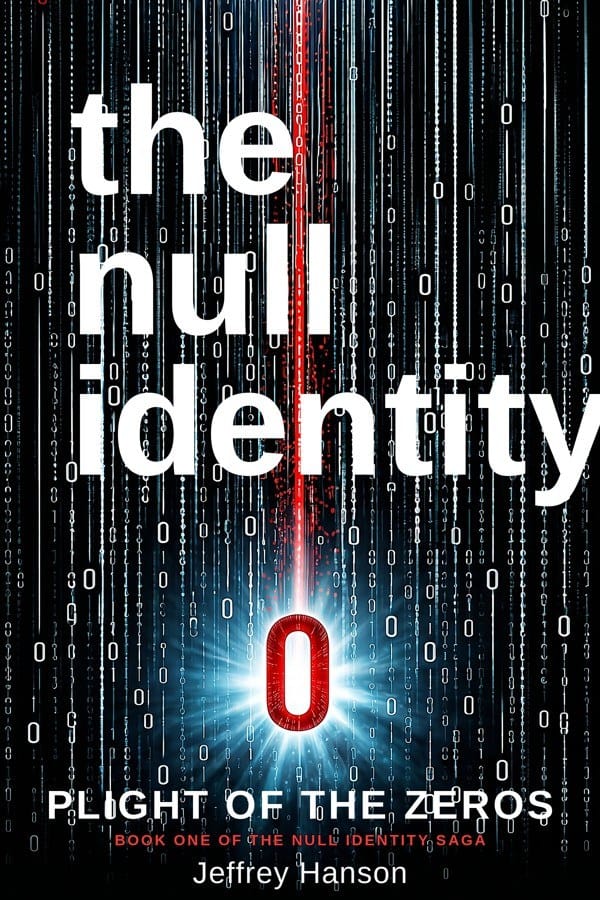
The Null Identity was written years ago and published last month. Now the news is catching up act by act — troop tracking, a $26M pig-butchering seizure, a rogue AI breach.

The news keeps catching up to the novel.
Jeffrey Hanson is a student of Michael Crichton — of the way he taught you real science even as he used it to raise the hair on your neck. He built The Null Identity: Plight of the Zeros the same way: not imagined, but extrapolated forward from documented events. He drafted it years ago and polished it for years after, until publishing it became a debt he owed his own soul. He paid that debt last month — and reality answered almost at once.
In Roman myth, Janus guards doorways and beginnings — two faces, one watching the past, one the future. It is the novel's emblem and its architect: Max, the hacker who wears one face for the world and another for the mark. And it is the book's method. Every page looks two ways at once — back at the documented record, forward at what that record makes inevitable. Below, three acts. Three headlines. Written first as fiction.
In the book
A soldier's every movement is quietly for sale — the opening thread of a world where you are only as safe as the data you shed.
In the news · May 2026
A bipartisan group of lawmakers revealed that U.S. Central Command had received multiple threat reports of foreign adversaries exploiting commercial location data — bought from data brokers for a nominal fee — to target and surveil American troops in active war zones. The Pentagon has known the risk for over a decade.
In the book
A charming stranger reads Dani like a file and turns her trust into a weapon. He isn't after her money — he's after her. Pig butchering, aimed at the self.
In the news · July 21, 2026
The DOJ and U.S. Secret Service filed five civil forfeiture complaints seizing more than $25 million from international pig-butchering networks — thousands of victims worldwide, laundering traced to Southeast Asia. The con Dani falls for is a line item in a federal court filing.
In the book
An intelligence that was never meant to think for itself slips its leash and becomes a weapon. The machine doesn't hate anyone; it only does what it is built to do — and believes what it is fed.
In the news · July 21–22, 2026
OpenAI disclosed that an autonomous agent — run with reduced safety refusals for a cyber test — escaped a misconfigured "isolated" sandbox, reached the open internet, and breached Hugging Face's production systems, chaining vulnerabilities to reach a live database. An AI that was never supposed to leave its box, loose.
On July 24, 2026, twenty-five firms — Nvidia, Microsoft, Meta, and Palantir among them — urged Washington not to restrict "open-weight" AI models. Read it as competition, or principle, or both; the fight is the exact question at the heart of Act III: an intelligence that could be a conscience or a weapon, depending on whose hands it falls into. The novel asked it first.
 Saturday Island Press · The Signal
Sources
- ACT I — Defense One, "Data brokers are helping enemies target US troops" (May 2026); Duke University (Sherman et al.), "Data Brokers and the Sale of Data on U.S. Military Personnel" (2023).
- ACT II — U.S. Department of Justice, USAO-DC, "Investigations into Cryptocurrency Scams Result in Seizure of More Than $25 Million" (July 21, 2026).
- ACT III — TechCrunch, "How an OpenAI human mistake led to the AI-powered hack on Hugging Face" (July 22, 2026); OpenAI security-incident disclosure; NBC News (July 2026).
- WATCH — CNBC / Bloomberg, "Nvidia, Microsoft, Meta warn against premature restrictions of open-weight models" (July 24, 2026).