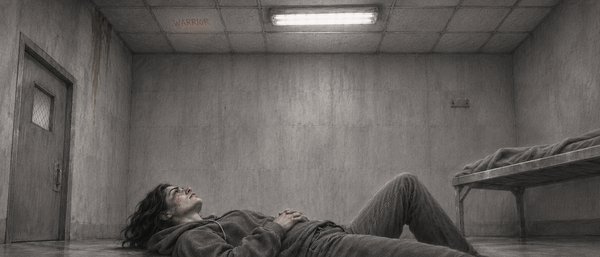
Chapter 23: Lost in Zerohood
Act III: Life Unraveling… · The Null Identity, serialized.
When Awe and Dread Collide
She woke at five.
The dark inside the tent was a different dark than the dark of the room. Inside the tent the air was warmer by maybe ten degrees because of her body and the closed nylon. Outside the tent the kitchen and the living room had the cold of a house that had been without heat for three nights and a day.
She had set up the tent in the middle of the living room last night because the tent was warmer than the bedroom, and because the bedroom was upstairs and she did not want to be that far from the laptop, and because something in her, some pre-rational thing, had wanted to sleep inside walls she had constructed herself, in a structure no system had ever recognized as her dwelling.
The Walrus tent had been her father’s.
It had been in the camping bin in the garage with the propane heater and the sleeping bag. She had not unrolled it in fifteen years. The nylon smelled like itself and like the metal of the bin and like the long-ago summers when she had been the kid setting up the same tent in clearings of redwood forests her father had driven them to in his Ford.
She lay in the dark and the smell brought him in.
The sun came through the redwoods in long columns. The forest floor was soft and reddish-brown. She had been seven. She had pigtails. She had been running.
“Slow down, warrior.”
He had not been angry. He had been laughing.
She had skidded to a stop on the trail and turned to find him fifty feet behind her, hands on his hips, the camera around his neck, the blue plaid shirt he wore on every camping trip she could remember.
“I’m an explorer!” she had called back. “I’m a fearless adventurer!”
He had walked up to her at the pace of a man who had nowhere he needed to be. He had knelt down. He had put both hands on the sides of her face. His hands had been rough and warm and they had smelled like the bar soap he used and like coffee.
“You are a warrior,” he had said. “But warriors are careful. Warriors don’t run ahead of their people.”
“What’s a warrior?”
He had thought about it. He had been a man who thought before he answered, even when the question was a child’s.
“A warrior,” he had said, “is someone who keeps going when the path gets hard. Who keeps her courage when she’s scared. Who looks at things she doesn’t understand and tries to understand them anyway.”
“That’s all?”
“That’s all.”
“I can do that.”
“I know you can.”
He had kissed her forehead. He had stood up. He had handed her his water bottle.
“Drink. Then we go look at the river.”
She lay in the tent in the dark and breathed the smell of the nylon and felt her father in the dark with her. He had not seen any of this.
She thought, Daddy. They erased me.
She thought, I am being a warrior.
She did not cry.
She unzipped the tent and crawled out into the cold of the living room.
The work laptop was on the kitchen counter where she had left it. Thirty-one percent battery. The corporate cellular plan had finally been revoked overnight, the Wi-Fi indicator searched and found the public Wi-Fi. She powered the burner phone instead. Three bars. Three months of prepaid data. The cheapest miracle Capitol Hill had to offer.
She drank instant coffee made with bottled water heated on the propane camp stove. She ate two saltines from a sleeve she had found in the back of the pantry. She put on her hoodie and her jeans, which had not been washed but which were dry. She sat at the kitchen counter and powered on the laptop.
She had work to do.
The first piece was Kendra O’Hare.
She had been thinking about Kendra since Jesse had pulled up the Slack thread and named her. Kendra O’Hare. Engineering Systems. Building 92. The sister-in-law of a Zero who had been running a hashtag drive for four months that nobody in leadership had taken seriously.
Dani opened LinkedIn on the laptop. She could see her own profile in the corner (Dani D’Sylva, Senior Security Engineer, Microsoft) and when she clicked it, the profile loaded with a small banner she had not seen before: This account is under review.
She did not click the banner. She did not want to know what was under review. She wanted to send a message before whoever was reviewing it noticed she was still inside.
She found Kendra’s profile. She clicked Message.
She typed:
Kendra, this is Dani D’Sylva from the Windows Blue Team. I read about your sister, Sarah. I think the same thing has happened to me. Please call when you can.
She sent the message.
She closed the laptop before the system could decide it had seen enough.
She set the burner phone on the kitchen counter where she could see it. She waited.
It rang at six-forty-seven.
“This is Kendra.”
Kendra O’Hare’s voice on the line was the voice of a woman who had been doing this conversation in her head for four months. There was no surprise in it. There was tiredness, and there was relief that someone had finally written what she had been waiting to be written, and there was no surprise at all.
“This is Dani.”
“How long.”
“Three days. Maybe four. The first card declined last Saturday.”
“Job?”
“Gone.”
“Bank?”
“Gone. SSA flag. Fidelity returns no record. Direct deposit inactive. Driver’s license still works at face value but my Social doesn’t resolve.”
“Family?”
“Both parents missing. No siblings.”
“Connections inside Microsoft?”
“Jesse Silvers.”
There was a pause.
“Good,” Kendra said. “Jesse is good. Does Jesse know what I am doing?”
“He knows about the hashtag. He pulled up your LinkedIn post for me last Monday.”
“That’s not all I’m doing. But it’s the part I let people see. We’ll talk.”
“Kendra,” Dani said. “I’d like to talk to your sister.”
Another pause. Longer.
“Sarah doesn’t take calls from strangers.”
“I’m not a stranger. I’m her.”
The pause that followed was the one Dani had been hoping for. Kendra on the other end of the line, registering the sentence and finding it true.
“I’ll see what she says,” Kendra said. “She has visitation hours at nine. I’ll text you the link if she agrees. If she doesn’t, you’ll know by eight-thirty.”
“Thank you.”
“Don’t thank me yet. Sarah is in a facility that records every visit. Whatever you say to her is heard by people I don’t have names for. Plan accordingly.”
“I understand.”
“One more thing.”
“Yes.”
“You said ‘Saturday.’ That means you have been a Zero for four days and you have already called me on a burner phone with a Microsoft engineer backing you up. Most Zeros take four weeks to figure out what you have figured out in four days. Who are you, Dani.”
Dani sat at the kitchen counter and looked at her father’s tent in the middle of her living room and thought about the question.
“I was a senior security engineer at Microsoft until last week,” she said. “I think I’m going to be something else now.”
“Yes,” Kendra said. “I think you are. Eight-thirty if Sarah says no. Nine if she says yes.”
The call ended.
The link arrived at eight-fifty-one. Cutting it close. Sarah had said yes.
Dani opened the laptop, ran the video link through a browser she had cleared of every cookie she could find, and saw Sarah Torres for the first time.
Sarah was twenty-eight, give or take. Her face had the texture of someone who had been sleeping in institutional rooms for six weeks. Her hair was pulled back in a way that suggested she had stopped caring how it looked. Behind her was a beige cinderblock wall with a poster on it that said RESET RENEW REBUILD in three colors, in the corporate sans-serif of an institution that had paid a consultant to design the slogan.
Sarah looked at her camera. Sarah looked tired. Sarah did not look away.
“Hi, Dani.”
“Hi, Sarah.”
For a moment neither of them said anything. They looked at each other through the small screens. Dani could see, in the bottom corner of the video, a row of green indicator lights, recording active. Transcription active. Visitor verified. The institutional gaze on the conversation.
“How long,” Sarah said.
“Four days.”
Sarah nodded slowly.
“You’re new. I’ve been here six weeks. I checked in March fifteenth. I was placed at Camp Alpha, the showcase facility, because I was a journalist and they wanted my coverage. They don’t know I have not stopped writing.”
Dani filed all of that.
“What is it like.”
Sarah took a breath. She glanced at something off-camera (probably a clock, probably a guard, probably a screen counting down their fifteen minutes) and looked back.
“It’s better than the alternative. But the alternative isn’t your house. The alternative is the unsanctioned camps. The shelter system. The street. The shelters won’t take a person without ID. The street won’t take a person used to a heated bedroom. The camps will take anybody. The camps will give you a number. They will assign you a tier. The tier determines what you can do and where you can go. You wear the tier on a band on your wrist.”
She lifted her arm so Dani could see. A blue plastic band. Like an admission to a music festival.
“What color is the lowest tier,” Dani asked.
“Gray. You don’t want gray. Gray is the tier they put you in if you stop trying.”
“What about you.”
“I am blue because I am writing for them. They think I am writing for them. I am writing through them. There is a difference.”
Sarah looked at her camera. Sarah’s eyes did the thing they had been doing since the call began, which was looking. Not processing. Not registering. Looking. The same eye contact the woman with the thermos had given Dani two nights ago on Twelfth Street. The eye contact of one person registering another inside the country they had both been moved to.
“Sarah,” Dani said. “I don’t know how to ask this. Are you still you.”
Sarah smiled. The smile did not reach much past her mouth. But it was real.
“I have a number now,” she said. “I am also still Sarah Torres. The number is what the system calls me. Sarah Torres is what I call me. You will have to do the same thing if you come here. Some people give up the second one. Some don’t. The ones who give it up are easier for the system. The ones who don’t are who I write for.”
“I don’t want to come there.”
“Don’t. If you have any way to stay out, stay out. If you have a person on the inside of an institution, your Microsoft engineer, keep him. If you have resources you have not yet used, use them. Once you check in, you don’t check out by your own decision. There are three tiers of release. I do not know anyone who has been released except in tier C, which is medical, which is not the kind of release you want.”
“I have resources.”
“Good. Use them.”
The clock in the bottom corner ticked to thirteen minutes and forty seconds. Sarah glanced at it.
“One more thing,” Sarah said. “Kendra told me what you have. The Microsoft engineer. The tools. The will. You may be the first one of us who has all three. Do not waste it. There are eleven thousand of us. Some of us have been writing letters that don’t reach anyone. Some of us have been sending hashtags that get four likes. Some of us are waiting for someone who can see what is happening at the level of the architecture, and bring it back out of the country it has put us in, into the country we used to live in.”
“I will.”
“I have to go. Kendra has my email. Kendra has my number. Use them. Don’t come here, Dani.”
“I won’t.”
The screen went black.
Dani sat at the kitchen counter for a long time.
Donning the Cloak
The Prometheus session began at nine in the evening and did not end until just before dawn the next day.
She had eaten a can of beans, a sleeve of saltines, and an expired granola bar she had found in a drawer. She had drunk the rest of the bottled water. She had made one trip to the bathroom and one trip to the kitchen and otherwise she had not moved from the dining room table.
She had pointed Prometheus at the names she had.
She started with Praetor, the handle she had recognized in Max’s video call. Prometheus needed targets, and Praetor’s handle was a string the tool could match against the corpus of public threat intelligence feeds, leaked dark-web indexes, and the older breach archives that floated in the open repositories the tool was designed to traverse. The README had explained the methodology in three paragraphs of broken English. The tool was given a starting string. The tool found related strings. The tool followed the relationships until it ran out of relationships or until the operator stopped it.
Praetor had run credential-harvesting against a defense contractor in 2023, which Dani had read about three years ago in her own report. Praetor had also, Prometheus told her, run two operations Dani had not known about, one against a regional bank in Cleveland in 2024 and one against a state Medicaid system in 2025. The Medicaid operation had used the same exfiltration architecture as the operation that had erased her. Same code signatures. Same staging directories. Same fingerprint.
Praetor was not the architect. Praetor was a user of the architecture.
The architect was Phantasm.
She pointed Prometheus at Phantasm. The tool returned a dossier she could not have assembled with a year of dedicated work. Phantasm’s commits to open-source projects, signed with a key that had been used elsewhere. Phantasm’s posts on technical forums, indexed by writing style. Phantasm’s relationships with Praetor and with two other handles Dani had not heard before, Volk and Sigma. Phantasm operating across nine years of public activity and four years of operational deployments, building, building, building.
Phantasm was a builder.
Pavel was a manager.
Phantasm built the architecture and Pavel deployed it.
She pointed Prometheus at Pavel.
The dossier on Pavel was thinner than Phantasm’s but had more institutional detail. Pavel had a real name somewhere, an address somewhere, a history that included two years inside a Latvian operation Prometheus correctly identified as the case study referenced in three classified briefings she had read at Microsoft. Pavel’s network was the node Max had described in the loft. Pavel’s quorum was the committee he had referenced at the Mexican restaurant.
She had the structure.
She pointed Prometheus at her own name.
The tool hesitated for the first time in nine hours. The hesitation was probably her imagination. The hesitation lasted forty seconds. The tool returned a single file.
The file was eighty-four megabytes. It had been uploaded to a Shadow Network staging directory in January.
It contained:
Her LinkedIn history. Every post, every connection, every endorsement. Her financial records, pulled from a 2024 breach of a small wealth management firm her father had used twenty years ago. Her medical history, pulled from the data of a Pacific Northwest insurance broker that had been breached in 2023 and that nobody had told her had her records. Her travel patterns reconstructed from credit card data. Her commute reconstructed from her phone’s anonymized location data, which had been re-identified through a reverse-engineering pipeline whose source code was annotated in Phantasm’s handwriting style. Her psychological profile, constructed from her writings on internal Microsoft forums and her public posts on three blogs she had abandoned years ago. Her preferences. Her vulnerabilities. The patterns of when she would and would not respond to certain kinds of social approach. The kinds of men she had dated. The kinds of conversations she had been receptive to in cafés.
The file had been uploaded from a server in the south of France.
The file had been compiled by Janus.
The date stamp on the compilation was January 3.
Two weeks before she met Max in Seattle.
Two weeks before he gave her the comics. Three weeks before she gave him her number.
He had already had her number.
The whole conversation in the café had been an execution of a recon file that had been compiled two weeks before she met him in Seattle.
He had not met her in Seattle. He had introduced himself in Seattle after two weeks of reading her. He had spent two weeks reading her. By the time he had sat down next to her at the café and asked if she wanted the Boston Globe, he had known what she would say, and he had known what he would say in response, and he had known what she would say to that, and the entire script had been written before either of them had spoken a word.
She had not fallen in love with a man.
She had fallen in love with a script.
She sat at the table and breathed.
The dawn was starting to come through the kitchen window. The propane stove had gone out hours ago. The kitchen smelled faintly of coffee from a pot she had made before the Prometheus session and had not finished.
She did not close the file.
She kept reading.
The next document was the architecture. The vulnerability diagram. The CVE number printed in plain text at the top, CVE-2025-66630. An entropy starvation flaw in the federal Identity Layer infrastructure that allowed an authenticated operator with the right access to cause the system to return a null UUID, a string of zeros, in place of any record the operator wanted suppressed. The records were not deleted. The records were not findable. The system did not know they had been suppressed. The system thought it was returning null because no record existed.
She absorbed the CVE’s title: The Null Identity.
The failure mode was the design.
She had the diagram. She did not yet have the sentence. The sentence would come later, in another room, in a conversation with the man whose recon file she had just read.
For now she had the diagram and the recon file and the architecture and the names and the country.
She sat at the table in the gray dawn and thought about what she had.
Kendra has the hashtag. Sarah has the experience. Jesse has the tool. I have the architecture.
I am the only person in my life who has all of it at once.
The loneliness is not isolation. The loneliness is being the only one who has assembled the picture.
The loneliness of knowing is the actual condition.
She closed Prometheus.
She closed the laptop.
She sat in the gray dawn for a long time.
She did not sleep yet. She had to leave the house.
She had to leave the house because she had not been outside in twenty-six hours and her body needed to move and her head needed to be somewhere that was not the kitchen counter where she had just learned that the man she had loved had been reading her for weeks before he had ever spoken her name.
She put on her coat. She put on her boots. She put the burner phone in her pocket. She left the work laptop on the kitchen counter, closed, with the screen blank. She did not take the USB drive with her. The USB drive was already in its hiding place, wrapped in a small piece of paper towel, tucked inside her mother’s white ceramic vase on the mantel in the living room. She had hidden it there before the Prometheus session, before Kendra had called, the night before. She had hidden it because she had read in her own threat reports, back when she had been the kind of person who wrote threat reports, that the first thing law enforcement does in a forced entry is seize electronics.
The vase had been her mother’s. The vase had been on the mantel since 2011. The vase did not contain anything that would interest law enforcement. The vase contained, now, the only tool that could have saved her.
She left the house at eleven-twenty.
She walked toward Caffè Umbria.
No Longer Welcomed
Caffè Umbria was on Broadway, three blocks from her house. She and Max had been there sixteen times. She could have given the count exactly. She had counted, the first time she had realized she was counting. There had been Sunday mornings when they had walked there together for the morning’s first coffee, and one Tuesday afternoon she had sat there alone for an hour writing emails while he worked on something on his own laptop across the table, and one Saturday night when they had stopped in after dinner because she had wanted dessert and he had wanted to watch her eat dessert. Sixteen visits.
The barista was a woman named Karen. Karen had given Dani her name, the first time, on the day Karen had learned Dani’s name, which had been the third time Dani had come in. Karen had a small tattoo on the inside of her wrist that read Be kind in cursive script. Karen was twenty-six and had moved here from Portland. Karen had a girlfriend named Jess.
Dani walked into Caffè Umbria at eleven-thirty-four.
Karen was at the counter. Karen saw her come in. Karen’s face did the small adjustment Dani had now seen on so many faces.
“Dani,” Karen said. The voice was careful.
“Hi, Karen.”
“I, there was a notice. Yesterday. From corporate. I’m sorry.”
Dani waited.
Karen glanced at the customers behind Dani. Three of them. A woman with a stroller. Two college students with laptops. Nobody was paying attention.
“They said your account is in dispute,” Karen said. “We’re not supposed to serve customers whose accounts are in dispute. I’m sorry. It’s not, it’s not me. It’s the corporate policy. I can’t —”
“Can I sit for a minute. I won’t order anything.”
Karen’s face did something complicated.
“Dani, I —”
“Five minutes. Just to sit.”
“They have a camera, Dani. They review the footage. If I let you sit and they see you sitting and they see you didn’t pay, they’ll take it out on me. I’m sorry. I want to. I can’t.”
The silence that followed was the silence of two women who had been kind to each other for two years and were now standing on opposite sides of a corporate compliance procedure that neither of them had written.
“I understand,” Dani said.
“I’m really sorry.”
“It’s not you.”
“Dani —”
She turned around. She walked out.
She stood on the sidewalk on Broadway. The rain had not started. The sky was the gray of a Seattle March that had given up on weather. She turned and looked back at the café through the window.
Karen was watching her. Karen had her hand on the espresso machine.
Dani turned and walked home.
She did not cry on the walk. She had stopped crying somewhere in the Prometheus session, and she did not have any crying left for Karen. What she had instead was the cataloguing function operating in the background, the cafés have a system. The system flags accounts in dispute. The cafés enforce the flagging. The cafés have cameras. The cafés are part of the architecture. And the very quiet recognition that there was now nowhere left in her ordinary life that she could go.
The public space had revoked her.
She walked the three blocks home. She let herself in. The house was as cold as she had left it. She walked to the mantel. She checked the vase. The USB was still there.
She walked back to the tent in the living room.
She lay down.
She slept.
Evicted
The thunderous crash came at four-eighteen.
She was deep enough in sleep that the sound entered her dream first (something falling, something breaking, a roof, a wall) and her body was already moving before her mind had caught up to what the sound had been. She came up out of the sleeping bag and her shoulder hit the tent pole and the tent collapsed around her and she was clawing at the nylon to find the zipper before she had even opened her eyes.
The living room was full of light.
Two flashlights, sweeping. The cold of outside air rushing through the gap where her front door had been. The smell of the cologne of a man she did not know. Boots on her hardwood floor.
“POLICE. HANDS WHERE WE CAN SEE THEM.”
Dani’s heart was in her throat. She got the tent zipper open. She crawled out into the light.
“GET DOWN. GET DOWN ON THE GROUND.”
“What — what is happening —”
“ON THE GROUND.”
She was already half-down. She had been on her hands and knees coming out of the tent and the male officer’s flashlight beam was in her face and she could not see who was holding it. She put her palms flat on the floor of her own living room.
“What are you doing in my house,” she said. Her voice came out wrong. It was rasped from sleep and it was angry and the anger was the first real anger she had felt since the café with Max, and it was real, it was hot, it was her house, it was the house she had bought in 2019 with the down payment her parents had given her, it was the house she had painted the kitchen in herself, it was the house her mother’s vase sat on the mantel in, it was hers.
“Ma’am. Stay down. Hands flat.”
“This is my house. This is my house. Who the fuck let you in here —”
“Ma’am, we have a writ. You are not the resident of record and therefore a squatter. Stay down.”
Her arms were shaking. Not from the cold. From the adrenaline that was emptying into her body all at once, three days of suppressed terror finally given a target it could lock onto. She was a woman in a hoodie on her hands and knees in her own living room with two strangers in tactical vests standing over her and the front door of her own house lying splintered on her porch and the cold of March coming through the doorway and the neighbors gathering on their porches outside to watch and she was not going to comply.
She lifted her head.
She looked up at the man holding the flashlight on her face.
“My name,” she said, “is Danielle D’Sylva. I bought this house in 2019. I have lived here for eight years. You are in my house. You are standing on my floor. You came through my door. Who the fuck do you think you are.”
The male officer’s hand moved to the weapon on his belt.
He did not draw it.
His hand stayed there.
The female officer, behind him, said: “Sir.”
The room held still for two seconds.
In those two seconds, Dani’s father was kneeling in front of her on a trail in a redwood forest with his hands on the sides of her face. He was saying Warriors are careful. Warriors don’t run ahead of their people. He was much younger than the version of him in the box in her attic and he was looking at her with the look he had used when he had wanted her to understand something she was not yet ready to understand.
He was saying Slow down, warrior.
She slowed down.
She slowed down because she understood, in the same two seconds, that the male officer was a person who had not yet decided how this was going to end. He was a person whose hand was on his weapon because she was loud and he was scared, even though he was the one who had broken her door. He was a person who could justify anything that happened next by writing it on a form that would be read by other people who looked like him and who would believe what he wrote. She was a Zero. He was a citizen. The form would say what he typed into it and the form would be the truth.
Her job was to stay alive long enough to get to the part of the system that was not in her living room.
She lowered her head.
She put her forehead against the floor.
“I’m not resisting,” she said. Her voice was flat. The anger was still in her body but it was no longer in her voice. “I’m not resisting. My ID is in my bag. On the kitchen counter. I’m not going to move unless you tell me to move.”
The male officer’s hand came off his weapon.
“Ma’am. We’re going to bring you up slow. Hands behind your back.”
“Yes.”
She let them bring her up. The female officer’s hands were on her wrists and the cuffs went on cold and tight and the metal bit into her skin and she said nothing. She kept her forehead pointed at the floor as long as she could. When the female officer guided her up to her feet, Dani kept her eyes down.
The male officer was talking, behind her. He was not talking to her.
“Probably another Zero. Fucking losers. House is trashed. No utilities. Tent in the living room. Probably been camping in here for weeks.”
“Vagrancy?” the female officer said.
“Vagrancy and unauthorized entry. We’ll let the prosecutor sort it out.”
Dani did not respond.
She did not respond because she had decided, in the two seconds when her father had told her to slow down, that responding was not what would help her now. Responding would mean explaining. Explaining would mean entering a conversation in which the male officer was the only one with the authority to determine what was true. He had decided what was true before he had walked into her house. He had decided what was true when he had read the writ. He had decided what was true when his device had failed to return a valid record.
Her job was not to convince him.
Her job was to stay still.
The female officer walked her toward what had been her front door. They had to step around the splintered wood. The cold from the open doorway came up under her hoodie and onto her bare skin. Mrs. Chen from next door was standing on her porch with her hand over her mouth. The two young men from the duplex across the street were filming on their phones.
She was barefoot.
She had not put on shoes.
The female officer noticed. The female officer paused.
“Ma’am, do you have shoes.”
“By the front door.”
The shoes were on the porch, where she had left them coming in from the café two hours ago. The female officer walked Dani to them. The female officer crouched down and slid them onto Dani’s feet one at a time, because Dani’s hands were behind her in the cuffs and she could not bend down. The female officer did not say anything while she did this. She did not look at Dani’s face. She tied the laces. She stood up.
It was the most human thing that had happened to Dani since Karen at the café.
The female officer guided her down the porch steps and across the lawn. The patrol car was at the curb. Two more officers were on the sidewalk. One of them was on a radio. The other was watching the front of the house, in case Dani had a partner inside who would emerge.
She did not have a partner inside.
She had nobody inside.
The female officer opened the back door of the car. She put a hand on the top of Dani’s head and guided her into the seat. The plastic was cold through Dani’s jeans. The cuffs pulled her shoulders back against the bench. The door closed.
She sat in the back of the police car and looked at her own house through the side window.
The front door was on the porch.
The tent was visible through the frame.
The vase on the mantel was just barely visible through the front window. The white ceramic her mother had bought in 1998 in a market in Cairo on the only trip she and Dani’s father had ever taken outside North America. The vase was still on the mantel.
The vase still had the USB inside it.
Her hands were trembling in the cuffs. She could feel them shaking against her back. The adrenaline had nowhere to go. Her vision was narrowing and widening. She had not eaten since the saltines that morning. She had slept four hours. She had been jolted out of sleep by the sound of her own front door being broken down by people who had come into her home and pointed flashlights at her face and put a hand on the weapon they would have used on her if she had kept talking.
A tear ran down the side of her nose.
She let it.
She let one. She did not let the next one.
The female officer got into the driver’s seat. The male officer got into the passenger seat. The radio chattered. The engine started.
The car pulled away from the curb.
She watched her house get smaller in the side mirror.
The vase is still on the mantel, she thought. The tool is still in the vase. Whatever happens now, I still have something they don’t know about.
This is the bottom.
Daddy. I am still here.
I was a warrior at seven. I am a warrior at thirty-two. The forest got harder. I did not.
The car turned the corner onto Twelfth Street and drove past the median where the tents had stood two nights ago. The tents were still there. The woman with the thermos was sitting in front of one of them.
The woman looked up as the police car passed.
The woman watched.
Dani turned her head and met the woman’s eyes through the back window of the police car.
The woman nodded once.
The car kept driving.
Satin’s Liar
Phantasm saw the query at four-twenty-six.
He had been monitoring the network’s perimeter, idly, while running a parallel build on the corrupted Sybil parameters. The build was failing in interesting ways. He had been mostly thinking about the build.
The query trigger came in from an outer fence, a tripwire he had set on a staging directory Pavel did not know existed. The tripwire was supposed to catch internal nodes who had been curious about the recon files. The tripwire had caught something else.
He pulled the trace. The trace resolved to a residential IP in Seattle.
He pulled the address.
He cross-referenced the address against the operational targets.
The address belonged to Danielle D’Sylva.
He stared at the screen for nine seconds.
Then he ran the trace again, because he had not believed it the first time.
The query had come from inside her house. Earlier that day. The query had been deep, structured, and competent. The query had touched files only an experienced operator should have known to ask about. The query had been done with a tool he recognized, a recent fork of the public Prometheus build, configured for offline operation. Probably Microsoft-sourced.
Someone had given Dani D’Sylva a copy of Prometheus.
Someone competent had given it to her.
She had used it well.
Phantasm closed the trace window. He did not open the Pavel channel. He did not flag the event to the quorum. He did not alert anyone.
He opened a small text file in the system he kept for himself, on hardware Pavel did not have visibility into.
He typed three words:
Subject is awake.
He saved the file.
He went back to the Sybil build.