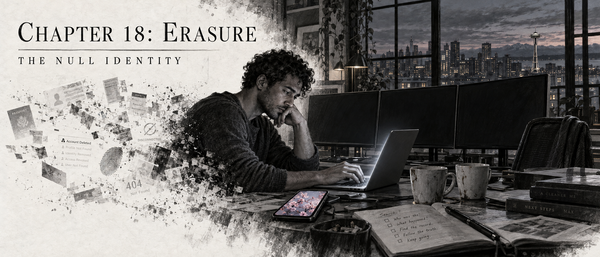
Chapter 21: Shattered
Act III: Life Unraveling… · The Null Identity, serialized.
The bus dropped her at Pike and Broadway in the last gray of afternoon. She had the laptop bag over one shoulder. By the time she had walked the four blocks to Max’s building, the streetlights had come on.
She stood at the bottom of the stairs and looked up at the windows on the third floor. One was lit. The light was the cold blue of monitors. He was awake. He was working.
She climbed the stairs.
She did not knock.
She stood at the door and considered it for three seconds. I won’t be erased. The words echoed in her mind, a battle cry against the injustice that had been inflicted upon her. She put her laptop bag down on the floor of the hallway. Without hesitation, she raised her leg and kicked the door, the solid wood splintering under the impact.
The deadbolt held but the strike plate did not. The door slammed open against the inside wall.
“I won’t be erased, Max!” she roared, bursting into the loft.
Max was up before the door finished swinging. He was three steps from his desk, hands raised in the half-motion of a man who had expected someone with worse intentions and was now recalibrating to find his girlfriend in the doorway.
On the largest monitor behind him, four faces in tiles.
The audio was still live.
“Janus?” one of the voices said. “Janus, is everything all right? We heard a—”
A second voice, sharper: “Who’s Max?”
Max turned and hit a single key. The faces vanished. The monitor went black.
The silence that followed was not really silence. The radiator was ticking. A laptop fan was running too fast in the corner. Outside, a car alarm started somewhere down the block and stopped.
“Dani,” Max said.
She picked up her bag. She walked into the loft. She closed what was left of the door behind her, pushed it as far as the broken jamb would allow, which was not all the way, and turned the deadbolt into the air where the strike plate had been, because the gesture mattered even when the function didn’t. She set her bag on the kitchen counter.
She looked at him.
She looked at him.
He was wearing the shirt he had been wearing in the café. Three days now. The collar was wrong. He had not shaved. His hair had the directionless quality of a man who had been running his hands through it for forty-eight hours. There was a takeout container on the desk beside his laptop, half-empty, with a fork in it, and another takeout container on the kitchen counter beside her bag, fully empty, and a third on the coffee table that she could not tell anything about from this distance. The loft smelled like fried rice and unwashed body.
Something in her, the cold useful thing that had been holding her composure together since the bus stop at Redmond, cracked a little. Not toward him. Toward, recognition. She had walked in expecting a man. She had found a Zero.
She did not let the crack show.
“Janus?” she questioned.
Max sat down on the edge of his desk. He put his hands on his knees. He looked at the floor.
“Dani —”
“Janus is your alias.”
“Yes.”
“How long.”
“Twelve years.”
“Was I —”
“Don’t.” His voice was raw. He looked up. “Please. Don’t ask me that one first.”
“Then tell me which one to ask first.”
He laughed. It was a terrible laugh. There was no humor in it, only the unfamiliarity of being asked a question by someone whose interrogation he could not parry.
“Sit down,” he said.
“I’ll stand.”
He nodded. He looked at the broken jamb. He looked back at her.
“What do you want to know.”
“Everything.”
He passed a hand across his mouth. He breathed out.
“His name is Pavel.”
She did not interrupt for the first ninety seconds.
Pavel was at the top of one operational node. Phantasm was the technical architect. There were others, distributed, in cities Max named and cities he didn’t. The Shadow Network was not a single organization. The Shadow Network was a register, a way of describing a class of operators who shared infrastructure and traded access without acknowledging a hierarchy. Pavel was a node. There were other nodes. There were nodes Pavel didn’t know about and nodes that didn’t know about Pavel. The peers Max had been on the call with three minutes ago were one of the nodes that pre-dated Pavel.
She interrupted when he said I gave them the access through you.
“Through me.”
“Yes.”
“Through me how.”
“You had the credentials to a system I needed. I —”
“Which system.”
“Internal. The dormant key vault. The MSA tier.”
She knew what that was. She had touched it twice in her career, once during an audit and once during a deprecation review. She had not thought about it in six months. She had not realized it was still active. Dormant did not, evidently, mean retired.
“You used me to get to the keys.”
“I used your access. I didn’t —” He stopped. He started again. “I told myself I was using your access. I had to tell myself it was the access.”
“And not what.”
He did not answer.
She let the silence run.
“What is Janus selling.”
He looked up.
“Keys,” he said. “Custom-fitted. He sells the keys to the kingdom. Whoever has the money.”
“Whose kingdom.”
“Microsoft’s, this time. Last year, a hospital chain in Ohio. The year before that, a federal contractor in Maryland.”
“You. You did those.”
“Janus did those.”
“That’s not an answer.”
“I know.”
She walked to the kitchen counter. She put her hands flat on it. She looked at the empty takeout container next to her bag. She breathed. She was not going to throw up. She had not eaten since a granola bar on the bus from Redmond and there was nothing in her to throw up.
She turned around.
“Pavel did this to me.”
“Yes.”
“Because of what you sold him.”
“Because of what I gave him access to. Yes.”
“And he was supposed to stop with the access. He wasn’t supposed to —”
“That was the deal,” Max said. “Yes.”
“He broke it.”
“He didn’t break it. He used me. The way he uses everyone. He used me to deliver the access and then he used the access to —” Max gestured at his own body, at the loft, at the wreckage of his own functioning — “to do this to me. To you. To do whatever he’s planning to do next.”
“Which is what.”
“I don’t know.”
“You don’t know.”
“I’m off the team, Dani. I have been since Wednesday. I came back to the loft on Wednesday afternoon and my Visa wouldn’t run and I tried to log into Sybil and the credentials had been —” He stopped again. He swallowed. “I’m a Zero. I have been since Wednesday morning.”
She had thought she was prepared to hear it. She was not.
She had walked into the loft prepared to confront the man who had erased her. She was looking at a man who had been erased by the same hand. The architecture had consumed him in the same motion it had consumed her. The man she had hated for forty hours had been hating the same architecture, alone in this Airbnb, with monitors and takeout scattered everywhere.
Her face did something. She did not know what. She felt it shift.
She made herself colder.
“Tell me more about Sybil.”
Sybil came out in pieces.
She was his. He had built her. He had been building her since 2018, since before the operator who became Pavel had recruited Janus into the network, since before adversarial AI had been a phrase outside academic papers. Sybil had been a research project. Sybil had become an operational tool. Sybil had, somewhere in the last eighteen months, become something else. Max used the word adaptive, and then he used the word aware, and then he stopped using words and let the silence say what he could not.
Phantasm had taken her.
“Took her how.”
“He had backdoor access. He’d been writing to her parameters for months. I didn’t see it. I should have. I was —” Max gestured again, this time at his own head. “I was somewhere else.”
“With me.”
“That’s not what —”
“That’s what.”
“Yes,” he said. “Partly.”
“Where is Sybil now.”
“With Phantasm. Wherever Phantasm has her. She’s not herself anymore. He’s pushing her toward —” Max closed his eyes for a moment. “Toward something. Something they’re going to deploy against Microsoft. Soon. I don’t know when. I’m off the team.”
“You said that.”
“I’m saying it again because it matters. I do not have current intelligence. I have what I knew on Tuesday.”
“You have nothing.”
“I have what I knew on Tuesday.”
She watched him for a moment. He looked smaller in the chair than he should have. He had been a large presence in his bed and in his morning kitchen and in the café they first met. He had been broad-shouldered and easy in the world. The man on the desk edge had no shoulders. He had a head and hands and the same shirt as the café.
“You’re trying to get her back,” she said.
“Yes. That’s what the call was.”
“Who were they.”
“Old colleagues. Pre-Pavel. They’ve been building their own. Different architectures. Different ethics, some of them, they’re not Pavel, none of them are Pavel, but they’re not, they’re not me either, anymore. They’re who I would have been if I hadn’t —” He stopped. Started over. “I was asking if they would help. If we could —” He gestured at his laptop. “If we could get the keys to the kingdom before Pavel does. Take the access back. Use it against him.”
“For money.”
“For the access. Whoever has the keys controls what happens next. If Pavel gets there first with Sybil weaponized, he doesn’t just do another zero campaign. He does something none of us has language for yet. I cannot let him do it. I cannot let Sybil do it.”
“Because she’s yours.”
“Because she’s Sybil.”
She held his eyes. He held hers.
The man who had been twelve years a mercenary was telling her, in this loft, with a broken door and an empty takeout container between them, that he had drawn a line at the AI he had built. That the line was about her, about Sybil. That he was prepared to fight the network he had served because of what was about to be done to a thing he had made.
She did not know what to do with the information.
She filed it.
He glanced over at the screen. She followed his eyes. The dark monitor reflected the room. One of the smaller monitors beside it was running a file directory, long scrolling lists of filenames, archive folders, dated backups.
“What are you doing.”
“Looking for something I can use. He ransomwared my backups. Phantasm. He left a—” Max made a small dismissive gesture. “He left a note. I don’t want to talk about the note. He encrypted everything I had on Sybil except the offline backup, and I’ve been —”
He clicked into a folder. He scanned it. He clicked again. He stopped.
“Huh.”
“What.”
“My initial build. From 2018. I forgot I kept it on the offline drive. Before she could do anything. Before—” He shook his head. “Useless. She couldn’t run a query. She couldn’t write a coherent line of code. It’s a research artifact. I don’t know why I’m even looking at it.”
He moved it to a folder on his desktop anyway.
He did not close the folder.
She watched him not close it. She did not understand the moment.
She did not yet know that the small unconsidered act of saving an early build to a desktop folder was the act that would, in eighteen months, become the most consequential decision Max would ever make. Neither did he.
She looked at the call window again, dark now, no faces. She thought about what she had seen in the half-second before he had killed it. Four tiles. Four handles. One of them had been visible.
“Praetor.”
He looked up.
“What.”
“On the call. One of the handles. Praetor. I’ve seen the handle before.”
“Where.”
“Threat report. Three years ago. He was attributed to a credential-harvesting operation against a defense contractor.”
Max did not say anything.
“You knew that.”
“I knew the operation.”
“You knew he was Praetor.”
“Yes.”
“He’s been on Microsoft’s radar for three years.”
“Yes.”
“Then so have you.”
He looked at her for a long moment.
“Yes,” he said.
She held the silence. The radiator ticked. She felt the architecture get one notch larger in her head. Max had not been a man who fell into this three months ago. Max had been a man Microsoft’s threat assessments had been mentioning, without naming, for years. She had read those reports. She had filed those reports. She had walked past her own warnings into his arms.
The cold came back into her. She let it.
She was going to need a shower.
“I need a shower,” she said. “And some food.”
Max blinked. He had been bracing for something else.
“Okay,” he said. “Yes. Of course. The, the bathroom—”
“I know where the bathroom is.”
“Right.”
She walked past him. She did not look at him as she passed. She closed the bathroom door behind her with deliberate care, because she had broken the front door and she did not intend to break any more doors tonight.
The hot water hit her shoulders and she put her hands against the tile and let her head hang. She did not cry. The water ran. The shampoo was the shampoo she had used the last time she had stayed here, which had been six days ago, which had been before any of this.
She washed her hair. She washed her face. She let the heat work the cold out of her hands.
She thought about Praetor and the threat report and the line she had written in the executive summary, which she remembered now, three years later, because she had been proud of it at the time: attribution likely but unconfirmed; recommend continued passive monitoring. She had written that line about the man on the call in the next room. She had been twenty-eight. Max had been Janus for nine years already by then.
She turned the water off.
She got out. She dried herself with a towel that had been hers, on the rack where it had been for two months. She looked at her wet clothes in the pile on the bathroom floor (the hoodie, the jeans, the t-shirt, the underwear) and she did not want to put any of them back on. They were cold and wet and they had been in the rain for two days and they smelled like the inside of her house.
There was a shirt of Max’s hanging on the back of the bathroom door.
She put it on. It came down to her thighs. She picked up her wet clothes in a bundle against her hip and she opened the bathroom door and she walked out into the loft.
Max was at the stove. He was preparing their meal. Something with a tomato sauce and her prized mushrooms. He looked up as she walked past.
His face, for half a second before he could control it, did the involuntary thing. The look of a man who had walked into his kitchen on a hundred mornings and found her standing exactly like this, in his shirt, hair wet, holding clothes. His mouth did the start of a smile.
He could not help it. The smile was already there.
She saw it.
“Don’t,” she said. The flatness in her voice cut the room. “Don’t even think about it.”
The smile did not finish forming. It died on his face in the same half-second it had begun.
He turned back to the stove.
She walked past him to the laundry room and put her clothes in the dryer and walked back into the kitchen and sat down at the small table by the window.
Neither of them said anything.
He set a plate in front of her. Pasta with red sauce. Garlic he had pressed from a clove from the bowl on the counter that she had bought for him three weeks ago. He gave her a fork. He sat down across from her with his own plate.
They ate in silence.
She ate. She had not eaten properly since the café. The food was hot and salty and she did not want to like it and her body liked it anyway.
He ate slowly, watching the plate. He did not look at her.
The radiator ticked. Outside, the street was quiet. The clock above the stove read seven-eighteen.
She finished her plate. He had not finished his. She put her fork down. She looked at him across the table.
She did not love him. She loved him. She had never been more certain of both at once. She had the names. She had the architecture. She had the shape of the thing. What she did not have was the means to survive while she did anything with it.
He did not look up.
She stood up.
“I need cash,” she said.
He walked to the bookshelf along the far wall. He pulled out the third book from the left on the second shelf, a hardcover she had not registered before, and reached into the gap behind it. He pulled out a flat metal case the size of a paperback. He brought it back to the table. He opened it.
Inside: bills. Hundred-dollar bills, banded in tens. She counted the bands at a glance. Twenty-six, maybe twenty-seven. The case was about half full.
He counted out twenty bands. Two thousand dollars.
He slid them across the table to her.
“I can’t give you more,” he said. His voice was thin. “I’m living on this too.”
She took the cash. She did not say thank you. She put the bills in the inside pocket of her bag.
“How long have you had a stash like that,” she said.
“Eight years.”
“Eight years.”
“You don’t last in this work without a way out.”
“You’re not lasting.”
He flinched.
“No,” he said. “I’m not.”
The dryer buzzer went off in the laundry room.
She got up. She walked back to the laundry room. She got dressed in her own dry clothes. She put his shirt on the back of the bathroom door where it had been before. She picked up her bag. She walked back into the main room.
Max was standing in the middle of the loft. He had not moved from where he had been when the buzzer went off. He was looking at his hands.
She walked toward the door.
“Dani.”
She did not stop.
She pulled the broken door open. She stepped through. She started to pull it closed behind her.
“I’m sorry, Dani.”
She did not turn around.
She pulled the door shut. It did not latch. It hung in its broken jamb. She heard him, on the other side, push it gently into place so it would at least look closed.
She walked down the stairs.
Capitol Hill in late March, eight at night, dry.
The air smelled like wet pavement and woodsmoke from someone’s fireplace and the faintly sweet rot of cherry blossoms that had dropped a week ago and were turning brown in the gutters. The streetlights made halos in the residual mist. Her hair was still damp under her hood.
She walked east on Pike. She had a mile to her own front door, give or take, depending on which way she cut. She walked the long way. She was not ready to be inside walls yet.
She passed a row of restaurants she had eaten in with him. She did not look at them. She passed the corner where they had once stopped because a busker had been playing something she had liked. She did not look at the corner. She walked.
At Twelfth, the road widened into a small median strip where, the last time she had walked this stretch on a date six weeks ago, there had been only landscape gravel and a sign about a community garden initiative.
The tents were there now.
Four of them. Tarps strung along the chain link of the construction site that had been a city park before the developers got it. The tents were arranged in the gravel as though someone had thought about windbreaks. A milk crate served as a chair outside one of them. A bicycle, missing a rear wheel, leaned against another. In the third, the flap was open, and a woman sat just inside, on a folded blanket, holding a thermos in two hands the way a person holds a thermos for the warmth, not for the contents.
The woman looked up as Dani passed.
Their eyes met.
The woman was maybe fifty. Maybe forty and tired. She had a knit hat pulled down over her ears. She had dark eyes. The eye contact was direct. It was neither defensive nor pleading. It was the eye contact of one person registering another.
Dani did not look away.
The woman gave her a small nod. Not a greeting. An acknowledgment.
Dani nodded back.
She kept walking.
She thought about Sarah Torres in a federal facility two weeks ago, having checked herself in because she had run out of options. She thought about PFC Torres, last contact January 9th, currently a record that did not resolve. She thought about Kendra O’Hare, hashtag SaveTheZeros, twenty-three reactions, four comments. She thought about the woman with the thermos. She thought about the woman she would be in three weeks if she did not figure out how to not become her.
She thought about Max in his shirt at his cooktop, and the smile that had begun on his face when she walked past him with her wet clothes, and the way the smile had died when she had told it to.
She thought about Max saying I’m sorry, Dani to the door she was closing behind her.
She thought, very clearly and without any further softening: He loves me. He destroyed me. Both are true.
She was not the woman who had walked into his loft three hours ago.
She kept walking.
The wound was integrated. The cold came back. It was not a wall. It was the shape grief took when she did not have time to grieve. She could feel the second wound sitting beside the first, both of them present, both of them hers. She would carry them. They were the only things she trusted now.
She had two thousand dollars in cash. She had an alias (Janus) and a network (Shadow) and three names (Pavel, Phantasm, Praetor) and the shape of an architecture that turned people into records that failed to resolve. She had an old colleague in Building 92 she had not yet met but would. She had a woman in the Office team on the third floor whose door was open.
Yesterday she had not known any of it. Today it was hers.
She had Max, somewhere behind her, alone in a loft with a broken door and a half-eaten pasta and a Sybil he could not reach.
She did not turn around.
She turned the corner onto Tenth.
Her own dark house was three blocks away. The lights would not come on when she opened the door. The heat would not be there to meet her. The phone would not ring. The system would not recognize her name.
Tomorrow she would learn how to live without any of it.
She kept walking.