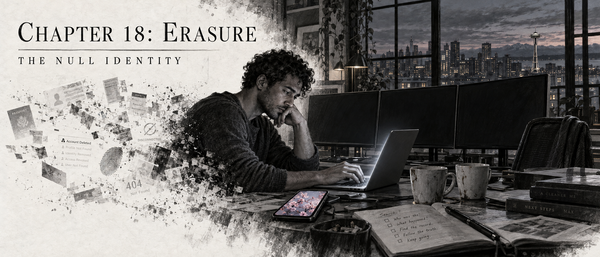
Chapter 19: DECLINED
Act III: Life Unraveling… · The Null Identity, serialized.
Dani woke alone.
The dream had been Max saying things she had not been able to hear properly even as he was saying them. She rolled toward the empty side of the bed and the cold of the sheets confirmed the emptiness in her morning.
She lay still and ran the weekend backward. The four dollars and four cents that had landed on both their phones at the same moment. His face when he saw it. The way he had said I need to tell you something and then had told her things that did not, even now, fully assemble into a story.
She closed her eyes. She wanted it to be a dream. It was not a dream.
The room was cold. She pulled the comforter tighter and lay watching the gray morning push against the blinds. Today would be a mental day off for her. No alarm. No standup. No reason to move.
Her stomach decided otherwise. She had eaten nothing since the café.
She swung her legs out from under the comforter and her bare feet recoiled from the wooden floor. The house felt wrong in a way she could not name. Too quiet, maybe, or too still.
She padded to the kitchen. The coffee maker did its work. She watched the pot fill and thought about Max’s hands and decided not to think about Max’s hands. The fridge had a quarter pint of half-and-half and a wilted bag of lettuce and the remains of a hummus container she had opened sometime around Valentine’s Day. She would need to shop.
She would shop. That was a thing she could do. Errands were a thing she could do. She did not have to think about the café yet. She did not have to think about the four dollars and four cents yet. She could put on jeans and a hoodie and go to the grocery store and buy eggs and bread and stand in line behind other people who were also buying eggs and bread, and the world would arrange itself around her in the way it normally did, and by the time she got home she would have decided what to do about Max.
She showered. She dressed. She put her phone in her back pocket and her keys in her jacket and she walked out onto the wet driveway and the MINI Cooper sat there in its bright blue patience, slick with morning rain, and she tapped her phone against the door handle.
She slid into the driver’s seat and pressed the ignition. The car woke. The dashboard lit. The infotainment system displayed its welcome animation. A familiar pop song faded in halfway through, Spotify resuming where her morning routine had left it. The car had not forgotten her.
As she backed out of the driveway, the rain thickened on the windshield and the wipers did their measured work. She pointed the car toward the grocery store and tried to let the music do its job. It did not quite. She lowered the volume so she could hear herself think and immediately regretted it because what she heard herself thinking was Max in the café saying I need to tell you something.
She turned the volume back up.
Halfway to the store, the song ended, and instead of moving to the next track the speakers gave her the local NPR affiliate, mid-sentence. — and according to the latest figures, the number of individuals reporting administrative identity issues has now passed eleven thousand nationwide, with several thousand currently being housed in temporary federal facilities pending —
She glanced at the dashboard. She had not switched to radio. The Spotify icon was still lit but no longer playing. The radio had simply arrived in its place.
— officials at the Federal Emergency Management Agency declined to specify how the facilities are being operated or what the criteria for —
She poked the screen. Spotify resumed mid-song. The radio voice cut out.
She drove the rest of the way with the music too loud. She did not want to know about eleven thousand people in federal facilities. She did not want to know about administrative identity issues. She wanted eggs.
The grocery store smelled like ground coffee and floor wax. The lights were too bright for the gray morning. A woman in a yellow apron was restocking limes. A child somewhere in the produce section was negotiating loudly for grapes. The world was correctly assembled.
Dani walked the aisles with her basket and made the decisions a person makes on a holiday. Eggs. Bread. The good butter, because she had earned it this week, or thought she had. Coffee beans. A bag of arugula she would feel virtuous about and then throw out wilted on Thursday. A bottle of the Merlot she liked. A second bottle of the Merlot, because Max.
She got in line.
The man in front of her had a cart full of children’s cereal and apologized to no one in particular when his card took two tries. The woman in front of him had paid in cash and counted it out with the unhurried precision of someone who did not own a smartphone. The cashier was young and bored and wore a name tag that said Heat. She assumed it was short for Heather.
Dani put her basket on the belt. Heat scanned her items without looking at her. The total flashed on the small screen at the end of the conveyor: $63.81.
She tapped her phone against the reader.
The reader beeped, but wrong. A short flat tone, not the cheerful ascending one. The screen blinked red.
DECLINED.
Dani’s face flushed before her mind caught up. No. She had four thousand dollars in checking. She had paid the mortgage on Wednesday. There was no version of reality in which the card declined.
“Hold on,” she said, smiling the smile she had used since high school to bridge small embarrassments. She swiped through to her credit card. She tapped again.
DECLINED.
“That’s odd.” Her voice was still bright. She was still inside the world where this was a glitch. “Let me try another one.”
She swiped. Tapped. DECLINED. She swiped to her Amex, the one she barely used. Tapped. DECLINED.
Heat looked up for the first time. Her face did the small unfortunate adjustment of someone preparing to be patient.
“Want to try a different card?”
“I’m —” she said, and then stopped, because she had now tried four. Her cheeks burned. Behind her, the man with the children’s cereal coughed, and the woman behind him shifted her weight, and Dani could feel without turning around the small social mass of strangers deciding what kind of person she was.
She forced the smile wider. “Sorry. Something’s going on with my bank. Can you hold these? I’ll come right back.”
The cashier was already pulling the basket aside. “Sure thing,” she said, with the practiced flatness of someone who had been asked to hold groceries for people who did not come right back. The cashier was already focused on the next customer.
She walked out of the store without her eggs.
The rain had picked up. She crossed the parking lot fast, hood up, phone already in her hand, thumbing at the banking app. The app opened. The app demanded her face. Her face unlocked it. The app loaded.
Unable to retrieve account information. Please check your connection and try again.
She had four bars. She checked. Five bars now.
She pulled to refresh. She pulled to refresh. She pulled to refresh.
Unable to retrieve account information.
She tried the credit card app. Different bank, different login.
Unable to retrieve account information.
She stood in the rain at the edge of the parking lot and a small cold thing began at the base of her sternum and started to climb.
She called the number on the back of her debit card. She once had a problem with a fraudulent charge from a hotel in Brussels she had never been to. The number rang. The number rang. An automated voice asked her to please say or enter her account number.
She entered the digits.
I’m sorry, I couldn’t find an account associated with that number. Please try again or say ‘representative’ to speak with a customer service representative.
She entered the digits again, slower.
I’m sorry, I couldn’t find an account associated with that number.
“Representative,” she said. Her voice was no longer bright.
Please hold while I transfer your call.
The hold music was a tinny synthesizer arrangement of a song she had liked in college. She hated the song now. She hated the rain. She walked toward her car holding the phone to her ear and the hold music played and played and after four minutes the call dropped.
She stood beside her car with the dead call in her hand.
Software glitch, she told herself. Some kind of outage. CrowdStrike again. It happens. She had been on the bridge call when CrowdStrike had taken down half the world’s airlines. She had spent forty hours debugging cascading failures. She knew what an outage looked like. This looked like an outage.
This did not feel like an outage.
She tapped her phone against the door handle.
Nothing.
She tapped again.
Nothing.
She frowned. She held the phone closer. The car was supposed to recognize the phone the way the building recognized her badge, proximity unlock, the whole point. She had not used a physical key in two years.
She pulled up the MINI app. The app opened. The app showed her car, correctly located in the grocery store parking lot, correctly identified as hers. She pressed Unlock.
The app spun. The app spun. The app said Unable to complete request. Please try again later.
“Fuck,” she said.
She tried again. The same spinning. The same message.
She stood in the rain looking at her car. The physical key was in a kitchen drawer at home, with the takeout menus and the dead batteries. She had laughed at it when the salesman handed it to her two years ago. Who would ever need a physical key?
She tried to call Max.
The call did not connect. Call failed. She tried again. Call failed.
She pulled up his text thread. She typed what is happening and hit send. The little green progress bar crawled along the top of the screen and then a red exclamation point appeared next to the message. Not Delivered.
She looked at the car. She looked at her phone. She looked across the parking lot at the entrance to the grocery store, where Heat was probably already restocking her basket back onto the shelves.
She put the phone in her pocket and started walking.
The mist had thickened into a steady drizzle. Each droplet a small icy needle against her exposed skin. She pulled her hood up and hugged her arms around herself, the thin hoodie offering very little against the chill. A mile and a half between her and her house. She had run further than this a hundred times. She had never walked it.
She walked it now.
She was a Microsoft engineer. She had two degrees. She had four credit cards. She had a 780 FICO and a house and an investment portfolio her father had started for her with a single deposit in 2008.
She existed. She was a citizen. She was a person.
Four cards. Four declines. Two banking apps offline. One car that no longer recognized her phone. One voice on a radio she had not chosen to listen to telling her about administrative identity issues and temporary federal facilities.
The small cold thing at her sternum was now in her throat.
She walked past a bus stop where a man with grocery bags glanced at her and then quickly away, the small reflexive glance of a person who has registered another person in distress and decided not to make eye contact. She walked past a coffee shop with steamed windows where people were warm and dry and looking at their phones. She walked past a parked Tesla whose owner was loading children into the back seat and laughing about something. The ordinary world conducted its ordinary day around her, and the ordinary world had no idea that she was no longer part of it.
She thought about Max.
She did not want to think about Max. She made herself think about Max anyway, because the alternative was to keep walking through the cold rain pretending none of this had a cause.
I need to tell you something, he had said in the café.
He had not finished the sentence. The four dollars and four cents had landed on both their phones at the same moment and his face had done something she had not been able to read and he had said her name in a voice she had not heard him use before. Dani. Just her name. And then I need to tell you something.
She had thought it was about them. She had thought it was the conversation people have when something has shifted between them, the one that begins I need to tell you something and ends in either a deeper closeness or a controlled goodbye. She had braced for the goodbye. She had not braced for whatever this was.
This had not been the conversation he was preparing for. This had been the thing he had been trying to warn her about.
Her shoes were soaked through. The rain was picking up. She walked faster.
She did not know if Max had done this to her or had been trying to keep this from her. She did not know if his face in the café had been guilt or fear or some shape of caring she had never seen on him before because he had never let her see it. She did not yet know which version of Max was the real one. She would have to find out. She would have to find him in order to find out.
But not yet. First she had to get home.
She thought about the eleven thousand people. Several thousand currently being housed in temporary federal facilities. The radio voice had been very calm. The radio voice had been delivering it the way the radio voice delivered traffic on the 520 bridge. Eleven thousand people who had become administrative identity issues and were now living in federal facilities whose criteria of operation FEMA officials had declined to specify.
She had not known that number this morning. She had not known the number existed. The number had been there the whole time and the radio had been saying it to other people and she had been driving past with the music up.
The rain ran down her face. She kept walking.
By the time she turned onto her own street, her teeth were chattering and her hands were shaking and she was not sure anymore whether the shaking was the cold or the rest of it.
She walked up to her house. It looked the same. The house was supposed to look the same. She fitted her key in the lock and pushed the door open and stepped inside and reached for the light switch.
A click. Silence.
She flipped the switch again, her heart pounding in her chest. Nothing.
The realization hit her like a punch in the gut.
The refrigerator, which she had not consciously noticed humming, was not humming.
She walked through her house in the gray afternoon light and tried every switch she passed. The living room lamp. The kitchen overhead. The hall light. The bathroom. Nothing, nothing, nothing, nothing. She stood in her own kitchen with her hand on a switch she had flipped ten thousand times and understood that she was alone in a cold house with a phone that did not work and a car that did not recognize her and a bank that could not find her and a man who had said I need to tell you something and had not finished the sentence.
She sat down on the kitchen floor.
She sat down on the kitchen floor because her legs had stopped supporting her. She put her back against the cabinets. The tile was cold through her jeans. The rain made its soft consistent sound against the windows. The house was darker than it should have been at this late stage of the morning, even in Seattle. The clouds were dense and the power was gone and the gray light coming through the windows was the only light there was.
She put her hands over her face.
She did not cry. She was too far past the place where crying would have helped. She sat with her hands over her face and let her breathing slow and let the cold of the tile come up through her jeans and let the truth assemble itself.
This was not a software glitch.
This was not an outage.
This was her.
Something had reached into the systems that surrounded her and had removed her, item by item, her card, her car, her phone, her power. The systems had not failed. The systems were doing exactly what they had been told to do. They had been told that she was no longer the person they were supposed to recognize. And so they did not recognize her.
She lowered her hands. The kitchen was very quiet.
She looked at her phone, dark on the floor beside her. She picked it up. The lock screen showed her wallpaper, a photo of Puget Sound from a ferry, taken eighteen months ago, before any of this. The phone still knew her face. The phone still had her photos. The phone still had Max’s text thread with Not Delivered in red.
The phone worked. The world had stopped letting the phone reach the world.
She thought of the café. She thought of the four dollars and four cents. She thought of Max’s face when he had said I need to tell you something.
He had been telling her this. He had been trying to tell her this and she had not understood and now she was sitting on her kitchen floor in a cold dark house and she finally understood.
Somewhere across the city, in a loft she had spent four nights of her life in, Max was awake or not awake, was working or not working, was guilty or not guilty, was on her side or not on her side. She did not know. She would have to find out. But not yet.
First she had to get up off the floor.
She got up off the floor. Her knees protested. The blood came back into her legs. She stood for a moment with one hand on the kitchen counter and waited for her balance to return.
She found her laptop bag. She pulled out her work laptop. She opened it. The battery was at sixty-three percent. The Wi-Fi icon searched, searched, searched, and found nothing. Her home router had no power. Of course it didn’t.
She activated the laptop’s hotspot. The corporate cellular plan still worked, the radio in the laptop talking to a tower that did not yet know what her phone’s tower knew. A small narrow tunnel back to the world. She opened a browser. She typed three words into the search bar with hands that were not entirely steady.
plight of the zeros
The page loaded an article from a small site she had never heard of, dated four months ago, written by someone named Sarah Torres whose husband was an Army PFC and was listed as MIA.
Dani read the article twice.
She closed the laptop.
She sat in the gray afternoon light in her cold dark house and held the closed laptop on her knees and understood, not yet with rage, not yet with the cold useful clarity that would come later, but with the simple flat recognition of a person who has been shown the name of the country she has just become a citizen of —
This is what is happening to me.
This has a name.
I am not the first.
The rain continued. The house stayed dark. Somewhere across the city, Max was the only person who could explain what came next.
She would have to find him.
Not yet. Soon.