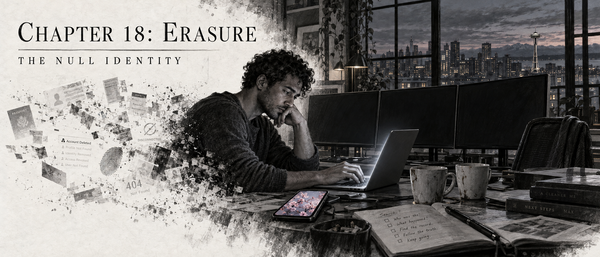
Chapter 16: Crossing
Act II: City of the Clouds · The Null Identity, serialized.
UW
She was wrapping up. Max could tell by the way she gathered her notes without looking at them, a habit he had catalogued in the first talk and recognized now as the specific signal that she was already three sentences ahead of her closing.
He had noticed the fumble in the middle section. She had recovered within a breath, clean enough that half the room missed it. He hadn’t missed it. He wasn’t sure anymore whether that was professional attention or something else, and he had stopped trying to decide.
The applause came. The cluster of students moved toward the front with their phones and their questions and their particular eagerness. Max stayed in his seat and waited without being asked to wait.
This was also new.
She found him when the last one left, jacket already on, bag already over her shoulder. She had the look of someone still inside the talk, turning it over, measuring the distance between what she’d prepared and what she’d delivered.
“Good talk,” he said. Then, because it was true and she would know if it wasn’t: “The Mandiant section landed. They were with you.”
She took this in, nodded once, moved it to wherever she kept things that needed more time. She was already somewhere else, the fumble probably, or the question she’d fielded without a clean answer. He recognized the quality of her distraction. He had catalogued it months ago. He had also, somewhere along the way, stopped thinking of it as a catalogue entry.
“Come on,” she said, already moving toward the door. “We’ve got a ferry to catch.”
Slightly startled, he caught up to her.
The Uber moved through Capitol Hill and down toward the water, the city mid-evening around them, restaurants still lit, the Pike-Pine corridor doing its particular weekday night business of people who lived nearby rather than visited. Dani sat beside him in the back seat and talked through the fumbled question the way you work through something that needs air, not really to him, not really to anyone, just aloud, the words finding their shape as she said them.
He listened. He was genuinely interested in what she was working through, the specific problem of explaining a technical concept to an audience divided between people who already understood it and people who needed the ground built beneath them first, the impossible geometry of a talk that had to work for both rooms simultaneously.
“The gap,” he said. “You lost them when you assumed the vocabulary. The second group needed one more sentence before the Mandiant reference.”
She turned and looked at him. Not surprised exactly. Recalibrating.
“Yeah,” she said. “That’s exactly it.”
She looked back at the window. The city moving past. Something had shifted in the quality of her distraction, less interior now, more present. He had asked the right question. He had not asked it for operational reasons.
He noted this.
The Uber crossed downtown and came down to the waterfront. Colman Dock appeared through the windshield, Pier 52, the ferry terminal lit and luminous against the dark water. A beautiful building. A modern statement in glass and warm wood and clean steel. The kind of infrastructure that moved people and impressed them while it did it.
“You’ve never been on the ferry,” Dani said. It wasn’t a question.
“No.”
“Good,” she said, and got out of the car.
Ferryboat to Knowhere
The terminal smelled of salt and wet concrete and the specific cold that came off moving water. Not a comfortable cold. A working cold, the cold of a place that had no interest in your comfort, only in getting you across.
The ferry to Bainbridge was boarding. The line moved through the terminal with the practiced efficiency of people who did this regularly, tickets or passes already out, no consulting of signs, no hesitation at the turnstiles. Max followed Dani through and onto the loading ramp and then up into the passenger cabin of a vessel that was considerably larger than he had expected, three decks of it, lit from within, the engines already running somewhere below them in a low continuous register he felt more than heard.
The passenger cabin was nearly full.
A contractor in a canvas jacket with dried paint on the cuffs stood by the window with a coffee cup, watching the dock. A woman in her fifties with two grocery bags wedged between her feet scrolled her phone with the weary focus of someone checking off the last task of a long day. A family with two children, the younger one already asleep against a backpack, the older one pressing her face against the glass to watch the loading. Two men in their thirties in the easy silence of people who commuted together and had long since run out of things to say that couldn’t wait until tomorrow. A teenager with headphones doing homework on a laptop, not looking up.
These people were going home. Not traveling, not commuting in the abstract sense, going home, to the island, to the particular lives they had arranged on the other side of the water. The ferry was the price of those lives and they paid it without thinking about it.
Max stood in the middle of the cabin and looked at them. He did not reach for his operational vocabulary. He did not find pressure points or assess leverage or map the social geometries of a room. He just looked at people going home.
Dani was already heading for the stairs to the outside deck. He followed her up.
The outside deck was cold in a way the cabin wasn’t, the kind of cold that arrived with the water moving beneath them and the dark sky above and nothing between you and either of them. Max came through the door and felt it immediately, specific and clean, the cold that lived at the intersection of salt water and night air.
The smell hit him next. Marine diesel from the engines below, heavy and slightly sweet in a way that shouldn’t have been pleasant and was. Salt water. The particular mineral quality of Puget Sound, different from the Mediterranean, different from anything he had a reference for, colder and darker and older somehow in the way it registered at the back of the throat. Wet rope. Cold metal. Something organic from the water itself that he could not have named.
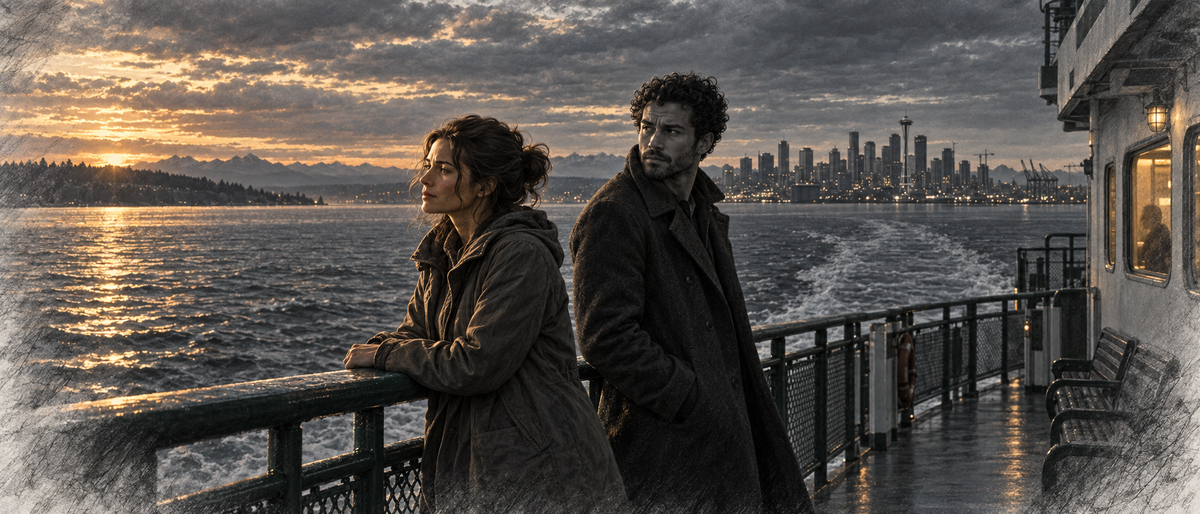
Dani was at the rail, looking back at the city.
Seattle was pulling away behind them, the lights of the waterfront and then the lights climbing the hill behind it, the city arranging itself the way it only arranged itself from the water, in layers, each district finding its own illumination against the dark. He had looked at this city from inside it for months. He had looked at it from the Space Needle on the bluebird day and from kayaks on the bay and from the windows of her loft at night. He had not looked at it from the water, moving away from it, the city becoming the thing you were leaving rather than the thing you were in.
It looked different. He didn’t have a word for how.
Dani turned and pointed toward the west, toward the darkness beyond the bow. “Olympic Mountains,” she said. “You can’t see them right now but they’re there. On a clear day from the middle of the Sound you can see both ranges at once, the Olympics west and the Cascades east, and Rainier to the south. The whole thing.”
“The whole thing,” he said.
“People drive all their lives and never see it,” she said. “The ferry gives it to you twice a day.”
She turned back to the water, leaning on the rail with the ease of someone who had stood in this exact position a thousand times. She was not performing the crossing for him. She was having the crossing, the same crossing she always had, and he happened to be beside her.
He put his hands on the rail next to hers and looked at the dark water moving beneath them.
The city fell away behind them. The island was out there somewhere in the darkness ahead, the engines below working steadily, the deck moving in the faint long rhythm of the Sound. The wake spread out behind them, the white of it briefly visible against the black water and then taken by the dark.
He became aware of the moisture at some point. Not rain exactly, not the gray assault he had categorized and resented since January, something subtler than that, the air itself simply wet, the way the air here was always wet in March, the kind of moisture that accumulated on your jacket without announcing itself, that you noticed on your sleeve before you noticed it on your face. He had been standing in it for some time. He had not, at any point since they came through the door onto the deck, thought of it as something to manage.
He stood with that for a moment, the way you stand with something that has arrived without explanation. It was wet. He was standing in it. He had not minded.
He did not tell Dani. He did not reach for the operational language. He let it stay where it was, sitting in no particular file, belonging to nothing he had a name for.
The foghorn sounded.
It came from directly above them, somewhere on the upper structure of the vessel, and it was not the decorative sound of a tourist boat, not the polite signal of a vessel that wanted to be noticed. It was the working voice of a large ship communicating its position in the dark, a sound that belonged to navigation and fog and the serious business of not colliding with other large things in black water, and it was enormous, filling the air completely for three full seconds, pressing against the chest, driving everything else briefly out.
Dani grabbed his arm.
Not a considered gesture. Reflex, the startle reflex, the thing the body did before the mind caught up. Her hand closed on his forearm and then, when the sound faded and she registered what she’d done, she laughed, a short exhale of surprised embarrassment.
“Every time,” she said. “I’ve been on this ferry a thousand times and every time.”
Her hand was still on his arm. She hadn’t moved it.
He didn’t move either.
“It’s designed to do that,” he said. “The frequency. It’s calibrated to carry.”
“I know,” she said. “Still gets me.”
She loosened her grip but didn’t let go, her fingers finding a lighter hold on his jacket sleeve, not clutching now, just present, the way you kept a hand on something after a startle because the body needed a moment to confirm the world had returned to normal.
He looked at the dark water ahead of them. The island was out there. He could not see it yet.
She did not move her hand.
Bainbridge
Bainbridge arrived as darkness and dock lights and the particular quality of a place that had finished its evening. The engines reduced to an idle and the ferry swung in a wide slow arc and found the slip with the practiced indifference of a thing that had done this ten thousand times.
The cabin began emptying before the ramp was down. These were people who knew the timing, who stood and gathered before the announcement, who moved toward the exits with the memory of every crossing in their feet. Max and Dani came down from the outer deck and were carried in the flow of the disembarking crowd out onto the dock.
The island at night was quiet in a way Seattle never was. Not silent. Quiet in the sense of a place that had made its peace with the dark, that did not push light into every corner, that accepted the night as part of the arrangement. The dock lights lit the immediate area and beyond them the island went about its business in the dark.
They stood on the dock. The last of the Bainbridge passengers dispersed into the night, toward parking, toward homes, toward whatever waited for them on the other side of the crossing. In two minutes the dock was nearly empty.
Dani stood beside him and looked at the island she had not moved toward.
He had not moved toward it either.
“We’re not going anywhere, are we,” he said.
“I live in Capitol Hill,” she reminded him.
They stood there for another moment, the island quiet around them, the ferry behind them with its engines still running, the water moving in the slip. A handful of Seattle-bound passengers were already beginning to form a loose queue on the dock, younger, lighter in mood, the energy of people heading toward something rather than home. They had their phones out. Someone was laughing about something.
Dani joined the return line.
Max joined her.
The return crossing was quieter between them. The decompression was complete. She had finished processing the talk somewhere between Colman Dock and the foghorn, had set it down in the way that meant she had found the file for it, would look at it again tomorrow with clearer eyes. The urgency was gone.
They found a spot at the rail on the starboard side and the city came toward them across the water, Seattle assembling itself on the return the way it only assembled itself from this direction, from the Sound, the layers of light coming back into coherence as the distance closed.
He looked at it and it was not the city he had arrived hating in January. He could remember hating it, could reconstruct the specific inventory of his contempt, the rain and the puffer vests and the corporate earnestness and the particular smugness of a city that had convinced itself that proximity to mountains and water conferred moral credit. He could reconstruct it and it no longer matched anything he was actually looking at.
At some point she had taken his arm. Not the grabbing reflex of the foghorn, something quieter, her arm through his, her shoulder against his. She was looking at the city the way she always looked at the city, with the proprietary affection of someone who had chosen it and continued choosing it.
He let the city come toward them.
He was aware of the things he would not tell Sybil. The fumble in the talk and the right question he had asked and the way she had looked at him after. The Uber, her thinking aloud, his listening. The terminal and the passenger cabin and the people going home. The moisture on his jacket that he had not filed. The foghorn. Her hand on his arm. Bainbridge in the dark. The return line. This, now, the city coming back across the water, her arm through his.
The list had become its own record. Parallel to the operational record. Unexamined. Growing. He had stopped trying to decide what to do about it.
The ferry found the slip at Colman Dock with the same practiced indifference as it had found Bainbridge, the engines dropping to idle, the ramp coming down. The city was right there, the waterfront, the lights, the wet street visible through the terminal windows.
They walked off the boat in the flow of the returning passengers and out through the terminal and onto the street. The moisture was still in the air. The street gleamed under the lights the way Seattle streets gleamed on wet nights, each puddle holding the reflection of whatever was above it, the city doubled in every surface.
Dani pulled her jacket tighter with her free hand. She was still in the crossing somewhere, still in the quiet of the return, not yet back in the city entirely.
He was aware of her arm through his. He was aware of the wet air. He was aware of the city around them and of the list of things he would not report and of the compartment that had stopped closing.
He was not, at this moment, anyone he had a name for.
He walked beside her into the city and did not reach for one.