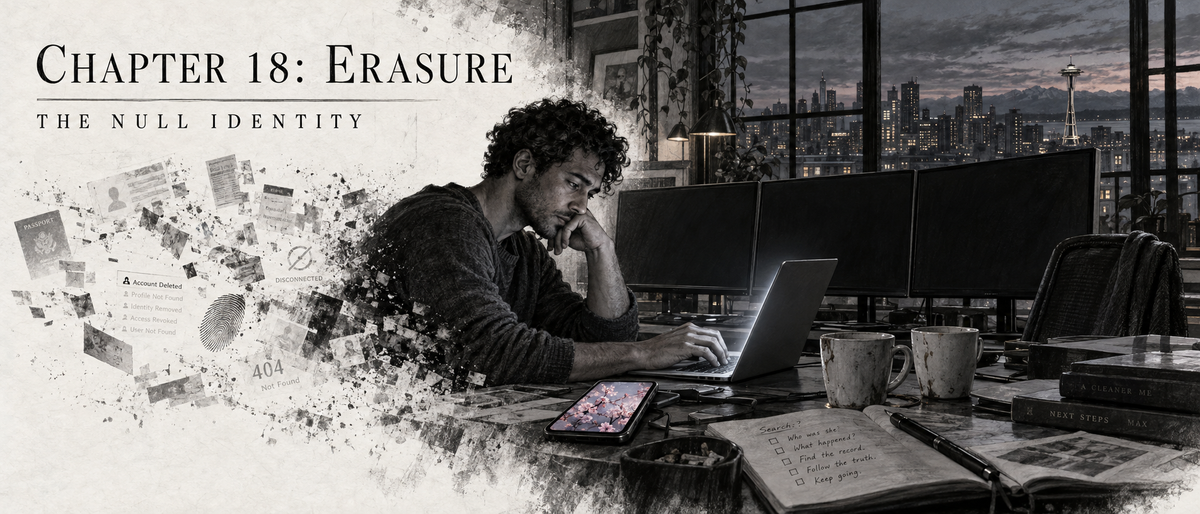
Chapter 18: Erasure
Act II: City of the Clouds · The Null Identity, serialized.
Capitol Hill
The morning came through the windows the way March mornings came in Seattle, gray and diffuse and without announcement, the city assembling itself in the light below.
Max lay still and looked at the ceiling.
“Sybil. Status.”
The silence that followed was not the silence of a maintenance window. He had learned the texture of those silences over the past ten days, had catalogued each one. Throttled functions had a quality. Scheduled rebuilds had a quality. This was different. This was the silence of nothing running at all.
“Sybil.”
Nothing.
He reached for his phone. 06:47. Sybil’s morning initialization should have run at six hundred. He had checked her before he slept and she had been there, running at 73%, the decision trees in their irregular rhythm, still processing. She had been there.
She was not there now.
He was about to swing his legs over the side of the bed when the arm came across his chest.
He went still.
Dani was asleep beside him, her breathing the slow even rhythm of someone deeply under, her face turned toward him, her arm settling across him with the unconscious weight of a person who had stopped calculating where her body was in relation to his. She made a small sound and drew closer without waking.
He lay with her arm across his chest and looked at the ceiling and felt the specific quality of a morning he had not planned for and could not have planned for and would not, if he were being honest with himself in the particular gray silence of 06:47, have planned differently.
Sybil was gone.
Dani was here.
He set the phone down.
She stirred at the movement, surfacing slowly, her eyes finding him in the gray morning light with the particular softness of someone not yet fully back in the world. She looked at him the way she had looked at him the night before, the way she had looked at him the first time and then the second time when the city had gone quiet and the loft had narrowed to the two of them and nothing else. Something in that look undid the operational reflex entirely.
He reached for her.
What followed was not the careful tenderness of the night before. It was the morning version of something that had been building for ten weeks, urgent and honest and stripped of the last residue of performance, both of them fully present in the way that only happened when the machinery of self-management had been running too long and finally gave out. She pulled him close with the specific grip of someone who had decided, without deciding it, that this was where she was. He gave her everything he had that was real, which was more than he had known was there, and she received it and returned it and the gray morning light held them without comment.
Afterward she lay against him, her breathing slowing, her hand open on his chest.
He held her.
Not as a calculation. Not as management of operational proximity. He held her because she was there and because the night had produced something he did not have a category for and because the silence in the corner of the room where Sybil’s voice should have been was pressing against him and she was the only warm thing in the loft and he was not ready to let go of the warm thing.
She was the one who moved first. She pressed a kiss to his jaw, the specific brevity of someone who has somewhere to be, and slipped out of the bed with the easy unselfconsciousness of a woman who had stopped being careful about being seen.
He watched her naked backside cross the loft. The city through the windows behind her. The morning light gray and diffuse and entirely indifferent to what had happened in this room.
She disappeared into the bathroom. The sound of the shower starting. Water on tile, the ordinary sounds of a morning that had become ordinary in the way that only the most significant mornings became ordinary, by containing too much to process and proceeding anyway.
He lay there for a moment longer.
Then he got up.
He crossed to the console. The monitors were dark. Not the dim of a throttled system. Not the irregular rhythm of the degraded decision trees he had been managing for ten days. Dark. The particular darkness of a system that had not merely paused but departed.
He sat. His hands were steady. They were always steady.
He ran the logs.
Clean shutdown. 03:14. No error flags. No triggered safeties. No shutdown command from him.
He checked the Phantasm access record. The repair permissions had closed on schedule three days ago. Sybil had been running at 73% since. She had been running at 73% during the dinner, had played the acoustic music, had engaged with Dani’s question about the distinction between efficient and right. She had been there when he checked before sleep.
She was not there now.
He ran the diagnostic again. The results were identical. He ran it a third time because the operational mind did not accept identical results when the results were wrong, because identical results that were wrong meant the problem was below the diagnostic threshold, which meant the problem was not a failure but a removal.
He sat with that word.
Removal.
The shower continued in the other room, the sound of Dani moving through the ordinary motions of a morning she believed was the morning after the best night of her life, which it was, which it also wasn’t, which was the specific nature of everything that had been true in this loft for ten weeks.
His phone was on the desk beside the keyboard. Pavel’s channel was dark. He had not checked it in three days.
He checked it now.
One message. Sent at 03:17. Three minutes after the clean shutdown.
Three words.
It is time.
He stared at the screen.
The shower stopped. The sound of Dani moving through the bathroom, her feet on the tile, the small sounds of someone almost ready to emerge.
He closed the channel.
He sat in the silence of the dark console and understood, with the specific clarity of a professional who had spent ten weeks managing the gap between what he was doing and what he was becoming, that the gap had just been closed for him.
By someone else.
The bathroom door opened. Dani came out with her hair damp and the morning on her face and the specific ease of a woman who had decided, somewhere in the night, that she was exactly where she was supposed to be.
She looked at him at the console.
“Everything okay?”
He turned. The smile arrived before he authorized it, which was no longer surprising, and then he looked at her face and the smile didn’t arrive at all.
He looked at her for a long moment. Her damp hair. The morning light behind her. The city through the windows. The loft that had been operational infrastructure and had become something else and was now, at 06:58, in the process of becoming something else again.
“No,” he said.
It was the first true thing he had said to her in nearly ten weeks.
Breakfast Promise
She crossed the room to him when he said no.
Not with alarm, with the specific attention she brought to things she wasn’t certain of, the same attention she had brought to Sybil’s console the night before. She put her hand on his shoulder and looked at the dark monitors and did not ask again what he had already answered.
“How bad?” she said.
“I don’t know yet.” True. Both true things he had said in the last thirty seconds.
She stood with him for a moment, her hand on his shoulder, looking at the dark screens. Then she pressed a brief kiss to the top of his head, the specific brevity of someone who understood that presence was the thing and questions could wait, and went to make coffee.
He listened to her move through the kitchen. The grinder. The particular domestic sound of a morning proceeding despite the thing sitting in the corner of the room that was wrong. He ran the diagnostic a fourth time. The results did not change.
He closed the laptop.
The Boston Globe was at the front door, as it had been every Sunday morning since he had started having it delivered, which had begun as persona maintenance and had become simply the way he started his mornings. He retrieved it and brought it to the table where Dani had set the two mugs, the coffee rich and specific, the smell of it the first ordinary thing in an hour that had been short on ordinary.
She was settled into the chair across from him, the robe wrapped around her, her hands around her mug, her hair still damp from the shower. She looked at him with the careful assessment of a woman who had accepted his answer and was deciding how much to accept it.
He separated the paper and held the comics section across the table.
She looked at it. Then at him.
“You’re impossible,” she said, and took it.
He took the front section and they sat in the particular quiet of two people reading a paper together, which was something he had not done with another person since he was a child and which had become, over the past three weeks, one of the things he noted without filing in the parallel record that had stopped being parallel and started being primary.
He was not reading. He was managing the diagnostic running in the background of his mind, the same diagnostic, returning the same result, the particular wrongness of a clean shutdown with no explanation sitting at the center of everything the morning was trying to be.
Dani set the comics down. She was looking at the front section now, the specific focus of a professional encountering something in her field. She read for a moment. Then:
“Another critical infrastructure attack.” She said it the way she said things she was thinking through, not quite to him, not quite to herself. “Airlines this time. Seventeen airports. Looks like ransomware.”
Max looked up from the page he was not reading.
“Same attack surface as the Continental Health collapse,” he said, before he had decided to. The words arrived from the professional layer, which was still running beneath everything, which was always running. “Different sector. Same legislative void.”
She looked at him with the specific surprise of someone who had expected sympathy and received analysis. Then, because she was Dani, the surprise moved immediately into engagement.
“Exactly.” She leaned forward. “The same unpatched vulnerabilities. The same failure to implement basic hygiene. My team spent six months developing a framework that would have prevented the vector they used here and I cannot get a single airline to run the pilot because the procurement cycle takes eighteen months and nobody prioritizes security until the planes are grounded.” She set the paper down. “It’s like shouting into a void.”
“You’re not shouting into a void,” Max said. “You’re documenting the void for whoever comes after you.”
She looked at him.
He looked back at her across the table with the comics between them and the coffee and the gray morning through the windows and Sybil’s silence in the corner of the room and understood, in the specific way of a man who had been telling partial truths for ten weeks, that he had just said something entirely true without intending to.
She reached across and took his hand.
“Think about what we could do together,” she said. Her voice was quiet, not a pitch, not a proposal, the specific register of someone thinking aloud about something they had been thinking about for a while. “You have the technical depth. I have the institutional access. We could write. Consult. Present at UW. The Power Couple of cybersecurity.” She smiled at the phrase, which was a joke and also not a joke. “We could actually move the needle, Max.”
He looked at her hand on his.
The operational mind arrived with its inventory. The timeline. The quorum. Pavel’s three words at 03:17. The dark console in the corner. The Microsoft credentials he had not yet extracted. The operation that had been proceeding with or without his participation since a clean shutdown at 03:14 in the morning.
He looked at her hand on his and thought about mushrooms bought without explanation and tea instead of wine and a photograph of cherry blossoms sitting in a camera roll with nothing around it.
“I’m not sure that’s what I want,” he said.
The words came out without the sharpness he had heard in his original version of them, the version he had run in his mind in the fraction of a second between her proposal and his response. They came out as something closer to honest, which was worse in a different way.
She heard the difference. He watched her hear it.
“What do you want?” she said. Not a challenge. A genuine question.
He looked at her across the table. The damp hair. The robe. The comics section between them, which had started as a prop in an engineered encounter ten weeks ago in a café with a Boston Globe and had become the thing they handed each other every morning without discussing when it had started or what it meant.
He did not have an answer that he could give her.
“Time,” he said. “I need a little more time.”
She held his gaze for a moment. Then she nodded, the specific nod of a woman who was accepting an answer she had not fully received and was deciding to let it be enough for this morning.
She picked up the comics. He picked up the paper. The coffee cooled between them. The city moved through the windows in the gray morning light, indifferent and patient, doing what it had been doing since before either of them arrived.
Sybil’s console sat dark in the corner.
The morning stretched on.
Price of Deception
By early afternoon they had ended up at a place on Pike Street that Dani knew and had been meaning to take him to, the kind of café that had been in the same location for thirty years and showed it, mismatched furniture, a chalkboard menu that hadn’t changed much since the nineties, the particular smell of a kitchen that had been making the same things long enough to have perfected them. Max had ordered coffee without looking at the menu. Dani had ordered eggs. The afternoon light came through the large windows low and specific, the city still deciding whether spring was a commitment or a suggestion.
Dani was scrolling through her phone with the idle attention of someone letting her mind rest after a morning that had required more of it than she had named. Max was looking out the window. Neither of them was performing the silence. That had stopped being necessary some time ago.
Then Dani’s thumb stopped moving.
She looked at her screen. Looked again.
“What was the name of that espresso place? The one at the market?”
Max turned from the window. Something in her voice had a quality he could not identify immediately, and the professional mind arrived before the personal one, the way it always arrived when something changed register unexpectedly.
She turned the phone toward him.
The charge was small. $4.04. The merchant name read: Not Found Café.
He looked at it for three seconds.
The warmth left the table.
He did not perform the leaving. It simply went, the way heat left a room when a window was opened, the temperature dropping before the source of the change could be identified. He felt it go and watched himself feel it go and could not stop either thing.
“Max.”
He looked up. She was watching him with the specific attention she brought to things she was not certain of, and what she was not certain of was him, and she was right not to be certain.
“It’s nothing,” he said.
She took the phone back. Looked at the screen again. Set the phone face down on the table, which was what he did with Pavel’s messages, and looked at him.
“That’s not your nothing voice,” she said. “That’s your something voice.”
He looked at the table. At his coffee. He thought about three words arriving at 03:17. He thought about a clean shutdown with no explanation. He thought about the photograph on his phone, sitting in the camera roll with nothing around it, belonging to nothing, which was still there, which he had not deleted, which he was not going to delete.
He thought about operation timeframe.
“Dani.” He said her name and then stopped because the sentence that followed it had several versions and he had been running them for ten weeks and none of them had ever felt like the right one and he had used that fact as a reason not to say any of them and the reason had run out.
She waited. She was good at waiting. He had noted this in the first week as a vulnerability to exploit and had spent the subsequent ten weeks understanding it as something else entirely.
“I came to Seattle for you,” he said. “But not for the reasons you think.”
She went very still.
The café moved around them. A couple at the counter. A barista calling an order. The ordinary sounds of a room full of people who were having ordinary afternoons, which was what this afternoon had been forty seconds ago.
“What does that mean?” she said.
He looked at her. Her face, which he had studied for ten weeks as data and had come to know as something that could not be reduced to data. The specific way she held herself when she was preparing to receive something she did not want. She had done this twice before in his presence. Both times she had received the thing and not collapsed under it.
“I was sent here to hack you,” he said. “To get into Microsoft through you. Your access. Your trust.”
The sentence sat between them on the table like an object that had been placed there.
She did not move. He watched her not move and waited for what came after the not moving and did not look away because looking away would have been the final and most complete cowardice available to him and he had decided, at some point between 03:17 and this moment, that he was done with that particular currency.
“Say that again,” she said. Her voice was quiet. Precise. The voice she used when she wanted to be certain she had heard correctly before she responded.
“I was sent here to hack you.”
The color left her face in a specific way, not dramatically, just the particular pallor of a person whose blood has done the calculation before their mind has finished it. She picked up her coffee. Set it down without drinking. Looked at the window. Looked back at him.
“By who,” she said.
“A network. Criminal. They’re called the Shadow Network. My handler is called Pavel. They needed Microsoft’s identity infrastructure. You were the approach vector.”
She absorbed this. He watched her absorb it the way he had watched her absorb difficult information in professional contexts, the mind working before the response came, the analysis preceding the reaction. She was doing it now with the information that the last ten weeks of her life had been an operation.
“The café,” she said. “The Boston Globe.”
“Yes.”
“The Canlis dinner.”
“Yes.”
“The ferry.” Her voice was still quiet. Still precise. Something moving underneath it that was not yet audible but was building.
“Yes.”
She looked at him for a long moment. The café around them continued its ordinary afternoon. The couple at the counter laughed at something. The barista called another order.
“And now?” she said.
“They’ve moved without me. The charge on your phone is a message. They’ve taken control of the operation. Whatever happens next happens regardless of what I do.” He paused. “Sybil was gone this morning. That’s what I was looking at. They took her.”
Something crossed her face at Sybil’s name. The specific flicker of a woman who had spent the previous evening talking to an AI about the distinction between efficient and right and had come away from the conversation changed by it.
“Is she—” Dani stopped. Tried again. “What does taking her mean?”
“I don’t know yet. Nothing good.”
Dani looked at the table. At her hands on the table. At the phone face down on the table with its $4.04 charge from a place that didn’t exist.
“I need you to tell me something true,” she said.
He waited.
“Did any of it—” She stopped. Started again. He watched her choose precision over speed, the way she always chose precision over speed. “When did it change. If it changed.”
He looked at her across the table. The afternoon light behind her. The café around them. The phone between them. Eleven weeks of operational record and the parallel record that had stopped being parallel.
“The cherry blossoms,” he said.
She looked at him. Her eyes were bright in the specific way of someone who was not going to cry in this café, who had decided that before she asked the question.
“I don’t know if that helps,” he said.
“It doesn’t,” she said. “And it does.”
She picked up the phone. Looked at the charge one more time. Set it back down. She was thinking. He could see her thinking, the mind working through the architecture of what he had told her, the technical implications, the personal ones. She would arrive somewhere. She always arrived somewhere. That was who she was.
“You need to go,” she said.
He looked at her.
“Not forever.” Her voice was steady. Steadier than he deserved. “I need to think. I need—” She stopped. “I need to not be looking at you right now.”
He nodded.
He reached across the table. Stopped before he touched her hand. Withdrew.
He stood. Looked at her once more. She was looking at the window, at the afternoon, at the city that was hers and that she had spent ten weeks showing him and that he had allowed himself to love in the specific way of someone who had not planned to love anything.
He left the café.
The door closed behind him.
Inside, Dani sat with her coffee and her phone and the afternoon light and the information that the last ten weeks of her life had been an architecture of deception built from everything she was and everything she had offered freely and everything she had not known to protect.
She did not leave immediately.
She sat with it the way she sat with difficult things, not collapsing, not fleeing, but present with the full weight of it, letting it be as heavy as it was.
Outside, Max stood on the sidewalk in the springtime air and did not move for a long moment.
He had said the true thing.
It had not made anything better. He had not expected it to. He had said it because the alternative was a version of himself he had decided, somewhere between 03:17 and this afternoon, he was no longer willing to be.
The city moved around him, indifferent and patient, doing what it had been doing since before he arrived and would continue doing after whatever came next.
He walked.
The Reckoning
The loft was the way they had left it.
Max had not moved anything. Had not cleaned the breakfast things from the table or closed the laptop or picked up the section of the Boston Globe still on the chair where she had been sitting when they read the paper together three hours ago. He had come back and sat at the dark console and had not moved since, his hands on the keyboard, the logs open, the clean shutdown still reading the same way it had read at 06:47 and every time he had run the diagnostic since.
He tried Pavel’s channel. Dark. He tried the backup channel. Dark. He tried the emergency contact protocol he had used twice in four years, both times at Pavel’s request, never at his own. Dark.
His phone buzzed. A notification from his cloud access portal.
Access suspended.
He set the phone down. He sat with this for a moment, Pavel unreachable, cloud access gone, the full picture assembling itself in the specific quiet of a loft that now had the quality of somewhere he had already left even though he was still sitting in it.
Then he heard the key in the door.
He had left it. He did not know if he had left it deliberately. He had not taken it from her and she had not given it back and so it was still on her keyring and the door opened and she came in.
She was not crying. She had been crying, he could see that, but she had stopped and what remained was the specific quality of a face that had been through something and come out the other side into a register that was colder and more precise than grief.
She did not look at him immediately. She looked at the loft. The breakfast table. The Boston Globe. The comics section on the chair. She looked at the console with its dark monitors. She looked at all of it with the systematic attention of a professional conducting an assessment.
Then she looked at him.
“I need my things,” she said.
“I know.”
She crossed the loft to the bedroom. He heard her moving in there, the specific sounds of someone gathering what was theirs from a space that had become partly theirs without a formal arrangement to make it so. He sat at the console and listened and did not go to the doorway.
She came back out with her bag. Set it by the door. Did not leave.
He turned in the chair.
She was standing in the middle of the loft, her arms crossed, her bag by the door, looking at him with the expression he had catalogued and never fully resolved and was now seeing at its most exposed, the warmth she had learned to deploy deliberately and the intelligence she had never learned to hide and the anger that she carried with the controlled precision of someone who had decided exactly what she was going to say before she came back through the door.
“Tell me how it worked,” she said.
He looked at her.
“The operation. The methodology. I want to know how it worked.”
“Dani —”
“I’m not asking because I want to hear you apologize.” Her voice was even. Precise. The voice she used in professional contexts when she had already done the analysis and wanted to verify it against the source. “I know what pig butchering is. I know what a social engineering operation looks like. I’ve written about it. I’ve lectured about it. I’ve warned people about it.” A pause. “Tell me how you targeted me specifically.”
He looked at the floor. Then at her. She deserved the precision she was asking for. He owed her that much.
“Sybil built your profile from public sources. Professional networks, forum posts, your blog. I was looking for someone at Microsoft with moderate access and limited local connections. Someone who —” He stopped.
“Someone who craved connection,” she said. “That’s the language, isn’t it? Social isolates. People who crave connection.”
He did not confirm it. He did not need to. She had done the analysis.
“The Boston Globe,” she said. “You knew I read it.”
“Yes.”
“The comics. You knew I read the comics first.”
“Yes.”
“The climbing gym. The farmer’s market. The coffee shop on 12th.” She said each one flatly, not as questions. The inventory of a woman who had been profiled and was now reading her own profile back to the person who built it. “My Duke forum post. My blog post about the healthcare breach.” Her voice didn’t waver. “You knew about my parents.”
Something changed in his expression.
“You read about my parents and you filed it as an approach vector,” she said.
“Yes.” The word cost him something. She saw it cost him and did not soften.
“And the ferry,” she said. “The cherry blossoms. The Space Needle.”
“Those weren’t —” He stopped.
“Weren’t what.”
He looked at her. “Those weren’t the operation.”
The silence that followed had a specific weight. She was deciding what to do with what he had just said. He watched her decide.
“No,” she said finally. “I don’t think they were.” She looked at the window. The city. The afternoon light moving across the floor. “That’s the part I can’t resolve. That’s the part I keep returning to.” She looked back at him. “You fell for me while running an operation designed to exploit me. Those two things are both true simultaneously.”
“Yes.”
“I don’t know what to do with that.”
“I don’t either.”
She looked at him for a long moment. He did not look away. He had decided that much, that he was done looking away from things.
“My parents,” she said. “Do you know what happened to them.”
The question arrived without warning, the way the most important questions arrived, and he felt it land in the specific place it was aimed at. He had been carrying the answer since the night he found the Shadow Network’s fingerprints in the fragments she had been collecting through her Microsoft access. He had carried it through the cherry blossoms and the ferry and the dinner and the morning and the café.
He had said the true thing in the café.
He said this one now.
“Yes,” he said. “I think so.”
She went very still.
“The Shadow Network,” he said. “The same infrastructure. Your parents were connected to something they shouldn’t have known about. I don’t have all of it. I have enough to know it wasn’t random and it wasn’t an accident and the people responsible are the same people who sent me here.”
She sat down.
Not because she chose to. Because her legs made the decision before she did. She sat in the chair by the window, the chair where she had been reading the Boston Globe four hours ago, the comics in her hand, the city behind her, both of them unremarkable in their ordinariness, and she put her hands on her knees and looked at the floor.
He waited.
“You knew this,” she said.
“Since the settled week. I found it in the data.”
“And you didn’t tell me.”
“No.”
She looked up at him. The anger was still there but it had acquired something alongside it, something more complicated and more enduring than anger.
“You had the information I have been looking for since I was twenty-six years old,” she said. “You had it and you held it and you cooked me salmon and took me to the cherry blossoms and held my hand on the ferry and you held it.”
He did not defend this. There was no defense of it. It was exactly what he had done.
“Why are you telling me now,” she said.
“Because you asked me to tell you something true.” He paused. “And because I couldn’t carry it anymore.”
She looked at him for a long time. He stayed in the look without managing it, without reaching for the operational frame that would have given him something to do with her expression. He just let her look at him.
“I need you to tell me everything you know,” she said. “About my parents. All of it. Whatever fragments you have.”
“I will.”
“Not today.” She stood. Picked up her bag. “I can’t do that today.”
She crossed to the door. Stopped with her hand on the handle, the same position she had been in three hours ago at a different door in a different moment that felt like a different life.
“The operation,” she said. “Microsoft. Are they going to proceed.”
“Yes. Phantasm has Sybil. They have what they built through me. They don’t need me anymore.”
“And me. Am I in danger.”
“Yes. The zeroing has probably already started.” He paused. “Check your accounts. Your cards. When things start failing it will move fast. You need to be ready.”
She absorbed this. The professional mind working. He watched it work.
“Is there anything I can do to stop it,” she said.
“I don’t know yet. I’m going to try to find out.”
She nodded once. The nod of a woman who had received information and was categorizing it and would determine what to do with it when she was somewhere that was not this loft.
She opened the door.
“Max.”
He looked at her.
She stood in the doorway with the city behind her and the afternoon light and ten weeks of something that had been real and was now this and looked at him with the expression he had never been able to fully catalogue.
“I believe you,” she said. “That it changed. That the cherry blossoms were real.” She paused. “I also believe that you used everything I am to get to me. Both of those things are true. I don’t know how to hold both of them yet.”
“Neither do I,” he said.
She looked at him for one more moment.
“Find out what happened to my parents,” she said. “Whatever you find, you tell me. That’s what you owe me.”
“Yes,” he said. “I will.”
She left.
The door closed behind her with the specific quietness of something that had been handled carefully on the way out, not slammed, not thrown, the quietness of a woman who had decided exactly how much force the moment deserved and had given it precisely that.
Max sat in the empty loft.
He sat in the quiet and did not attempt to clean up their morning mess.
Outside, the city moved through the afternoon with the specific indifference of a place that had held every kind of human reckoning and would hold many more and would not remember any of them.
He had told her the truth.
He had told her all of it, or all of what he had, which was not all of what there was, which meant there was more to find and he had promised to find it.
He had set traps like this before.
He had never been the one who had to find his way out.
Erased by His Own Hand
He opened the laptop.
He began.
Max sat at the console in the specific silence of a loft that had been two people’s and was now one person’s and would be no one’s within the week. He had told her he would begin. He had meant it. The beginning was the only thing he had left that was his, the work of finding out what happened to her parents, which was the one task she had assigned him, which was the one task he could do that was not damage.
He was three minutes into the first search when his phone buzzed.
A bank notification. $4.04. Merchant: Not Found Café.
He looked at it. Set the phone down. Looked at the laptop screen.
He had been zeroed out. A Zero now, like Dani. Like Torres. Like the people his attack packages had been built to destroy.
He noted the specific irony of this.
He sat with the second charge the way you sat with something you had been expecting and had not been ready for. The first charge had been Pavel taking control of the operation. This one was different in kind. This one was not a message about the operation. This one was a message about him.
He opened his primary accounts. Flagged. He tried the backup identity. Suspended. The third layer, the one he had built over seven years as the final contingency, the one that had never been touched. He navigated to it through four jurisdictions and two anonymizing protocols and found it exactly as he had left it.
For eleven seconds.
Then the screen refreshed.
Suspended.
He sat back in the chair.
He had zeroed out people. He had built the attack packages that made them disappear from their own lives. He had sat in a flat in Saint-Raphaël and watched the profiles collapse in real time and felt the craftsman’s satisfaction of a thing working as it was designed to work.
The accounts were gone or going. The access was gone. Sybil was gone. Pavel was unreachable. The quorum had what it needed and had no further use for the asset who had delivered it and had become, in the delivery, a liability.
He had built his own cage. He had not known he was building it. The accountability he had taken for Sybil’s degradation, the trust he had extended to Phantasm, the ten weeks of the operation becoming a life, all of it had been the construction of the mechanism that was now running on him.
He sat in the chair and looked at the dark console and did not reach for the operational vocabulary because the operational vocabulary had categories for system failure and external intrusion and asset compromise and it had no category for this, which was not a failure but a completion. The operation had completed. He had been the operation’s final deliverable.
Outside the windows, Seattle moved through its evening. The lights coming up on the water. The Space Needle lit against the dark. The city that Dani had shown him and that he had arrived hating and had stopped hating without identifying the moment, doing what it had been doing since before he arrived and would continue doing after whatever came next.
He thought about the photograph on his phone.
He reached for the phone. Opened the camera roll. The photograph was still there, the cherry blossoms against the gray-purple sky, the pale pink of them luminous in the diffuse light, one image in a camera roll that had contained nothing personal until a morning in late March when he had taken it without deciding to and not told Sybil and not told Dani and left it sitting in the absence of any file he had created for it.
He looked at it for a long moment.
Then he put the phone down.
He had one thing left that was real. The promise he had made when she walked out — find out what happened to my parents, whatever you find, you tell me. He had said yes. He had meant yes. He meant it now, sitting in the wreckage of the operation he had built and the life he had not planned for and the specific devastating clarity of understanding what he had been and what he had become and the distance between them.
He was also, still, the best in the world at finding things that had been deliberately hidden.
The city moved outside the windows. The lights on the water. The Space Needle holding its position against the dark the way it held its position every night, indifferent and permanent, belonging to no one and available to everyone, the way the cherry blossoms belonged to no one and were available to everyone for ten days in late March before the wind came and took them.
He had been paying attention.
He was still paying attention.
Janus was gone. The operation was gone. The access and the accounts and the infrastructure he had spent his career building, gone or going, collapsing in the specific quiet way that things collapsed when the mechanism had been designed to be invisible.
Max remained.
He did not know yet what Max was capable of without the operational architecture. He had spent four years building Sybil to extend what he could do. He had spent ten weeks building something with Dani that he did not have a word for. Both of them were gone.
He had his hands. He had the laptop. He had the promise.
He had the photograph of the cherry blossoms sitting in a camera roll with nothing around it, belonging to nothing, filed nowhere, taken without authorization from the part of himself that still believed it needed authorization.
He had been wrong about that. He understood that now.
He opened the first search.
He began to look for what had been done to her family in a city where corporations still advertised on the benches where men bled.
Outside, the world moved on.
It did not know he was still in it.
It would find out.
Nicholas Negroponte built the MIT Media Lab and helped launch WIRED. In 1998, while everyone else online was busy becoming someone new, he saw the value almost no one was writing about: not the freedom to be a different person, but the freedom to be no one at all. Someday, he predicted, you would want exactly that.