Chapter 2: Reconnaissance
Act I: Easy Data · The Null Identity, serialized.

Saint-Raphaël, France, December
“You’ve received a deposit equivalent to ten thousand euros in your bitcoin wallet,” the voice said into his earbud. The precise tone was smooth and carried something that wasn’t quite warmth but occupied its coordinates closely enough that Max had stopped noticing the distinction.
“Thanks, Syb,” he murmured, eyes fixed on the horizon.
“Of course.”
A pause. He had learned the difference years ago, and the difference still didn’t have a name he was comfortable using. Sybil’s processing pauses had a specific rhythm, predictable as clock ticks. This kind was the other kind: the kind that arrived after something human had been said, as if she were giving it space rather than analyzing it.
He had never asked her about it.
He had never asked himself why he hadn’t.
Outside, the sun went down in blood-orange and ash-purple across the bay. Max stood motionless, silhouetted in the glass. The payout had cleared. The mission was clean. He should’ve felt something closer to triumph. Instead, a quiet satisfaction—the calm of mastery. His father would’ve smiled at that. Or at least nodded.
He had built himself out of discipline and suspicion. The world taught him early to question everything. He never stopped. That hunger had led him from certs and clean code to exploits and darknets. From white-hat pen tests to professional ghost work. He never sought infamy, only proof. Proof that the system was built on illusion. That weakness, once discovered, was the only true currency.
Sunlight caught his old badge on a collateral tree. A heap of lanyards and conference credentials accumulated across a decade of believing systems were worth securing. The light glinted off the logo and held there.
He’d worn a badge once. Back then, he believed in protocol, in process. That his work mattered.
He still remembered the final swipe. Cold plastic against the card reader, the soft beep swallowed by the echoing lobby. The cardboard box on his desk said everything his supervisor wouldn’t. “It’s not you, Max. It’s the budget cuts.” As if that explained anything. As if trust was a line item.
He had played by the rules. And been discarded anyway.
So he rewrote the rules.
And then he met Pavel.
Pavel’s message blinked into Max’s encrypted chat window: “délai de livraison du paquet?”
“Sybil, tell him forty-eight hours,” Max said, peeling off his damp jeans with a grunt. “Done,” she replied with her usual poise.
They had never met, but trust had formed, not out of loyalty, but pattern. Pavel brought the contracts. Max delivered the chaos. Their shared brilliance lived in the margins of attribution.
Max had pioneered a tactic they called shadowing. He’d pore over threat intelligence reports of ransomware campaigns, nation-state incursions, zero-days cataloged by security researchers, then would mimic the exact methods. Everything from IP ranges to exploit chains. Enterprises struggled to patch fast enough, and those glossy annual reports? They were roadmaps for anyone who knew how to read between the lines.
Pavel would name the target. Max would run a Shodan sweep, pick a threat group as cover, and slip in under their flag. The aftermath would point fingers at China, Russia, or Lazarus. Never Janus.
His handle was whispered in forums, mythologized in breach chat. But he never took the mic at Black Hat. Janus wasn’t a brand. He was a consequence.
“The café downstairs closes soon,” Sybil said softly, nudging him from his chair. She knew his habit of losing time once locked in.
“Thanks,” Max replied, grabbing his jacket. The night was far from over.
The scent of espresso usually grounded him—a ritual comfort against the whir of cooling fans and key clicks. Tonight it grated. The baristas’ laughter was an intrusion.
Then: a flicker of blue. A Duke University logo, glowing faintly on a woman’s laptop across the room.
Max’s hand froze mid-sip. The espresso scorched his throat. Merit, service, the greater good—words that once meant something. Now just slogans, echoing in overpriced coffee shops.
He could still feel that agent’s handshake. The sincerity in his eyes. The lie.
Had he been naive? Or just late to see the rot?
No. Focus.
Data was truth. And Duke… Duke had dropped a bombshell years back.
“Sybil,” he said quietly, leaning forward like a soldier about to breach a wall. “Duke University. Data brokering. Military personnel. I want the price points. Actionable insights.”
“Working,” she replied.
Seconds passed. Then her voice returned, soft, efficient, lethal.
“I’ve located and summarized the December 2023 research from Duke. Full text available. I’ve also extracted preliminary action paths.”
“Summarize,” Max said, his voice like flint.
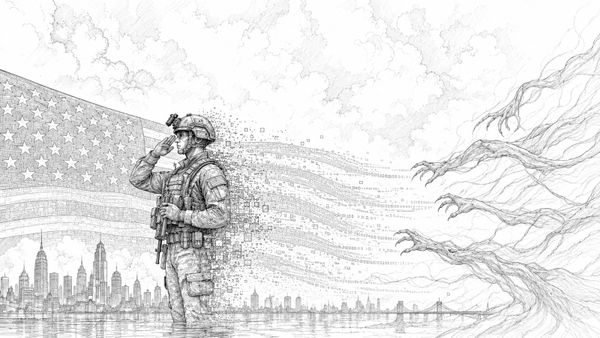
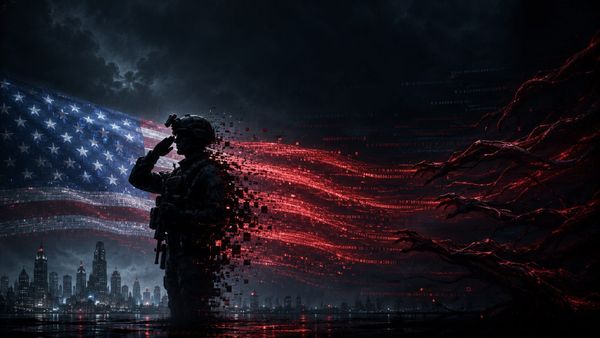
Sybil began, “The report confirms that sensitive data on U.S. military personnel, including health, financial, and location information, is available for purchase through third-party data brokers. Prices begin at twelve cents per individual. Deployment history, psychological profiles, and mission-critical metadata are included in many records. Verification processes are weak or absent. There is no comprehensive regulation.”
Max’s jaw clenched.
Sybil continued, “This data is legally obtainable. Analysts reconstructed potential threat vectors using only purchased datasets. The implication: an adversary could build targeted campaigns against military families, operations, or morale. They can do it without ever breaching a secure system.”
“They reconstructed family trees from adtech breadcrumbs,” Sybil added. “Retail data. IP history. Geolocation. It is more than enough to map out dependents, health vulnerabilities, and next of kin.”
A long silence followed, filled only by the hiss of steamed milk and the weight of revelation.
Max’s expression didn’t change. But something inside him settled. An answer to a question he’d been asking since the layoffs. Since the betrayal.
Here it is, he thought. The proof. The rot’s not in the code. It’s in the system.
He left the café with a quiet, measured grin.
Max and Sybil: The Street Session
Max circled the narrow streets outside his flat, moving like a man on a heated phone call: animated, muttering, focused. Passersby barely glanced at him. Talking to yourself in public was no longer strange. Not in a world where everyone spoke to ghosts in their ears.
“Let’s walk through the next stage of recon,” he said, voice low, cadence deliberate. “We’ve got more than just publicly available data now. We’ve got that sensitive military trove and a cache of compromised credentials.”
He paused at the corner, scanning his mental map.
“We need to isolate active-duty members, ideally those with current deployment orders. That means parsing ours and merging with a third-party dataset, something like what Duke uncovered. Their set has the good stuff: real-time location, family metadata. Ours has login creds. We stitch the two—”
“—and we’ve built a battlefield,” Sybil interjected smoothly in his ear.
Max nodded to no one. “Exactly. Once merged, we infiltrate military networks, log in with stolen creds, escalate access, and quietly pull live deployment schedules.”
Sybil’s tone shifted, approving, almost proud. “You’re working with four distinct datasets. The moment they’re joined, you’ll unlock a granular profile on a highly targeted subset of active personnel. Confidential, sensitive, and Top Secret, all in one sweep.”
At the steps to his flat, Max pushed the door open and let it creak shut behind him. Sea salt clung to the December air, but he ignored the dusk over the marina. His attention snapped to his screen.
“We construct profiles. Then we write the attack script.”
“I’ve already started parsing,” Sybil replied, crisp. “Filtering out deceased and retired members. Initiating data cleansing and normalization procedures for script integration. Forty minutes until ready.”
“Good. I’ll work the broker angle,” Max said, sliding into his chair. The espresso had cooled, but he drank it anyway, watching the last streaks of gold fade into night. Somewhere in the data, his next move was waiting.
“This dataset is rich,” Max muttered, eyes lit by the glow of monitors and a single desk lamp. “Nearly 3,000 tracking elements on each service member!”
The cool December breeze had turned sharp. He rose and closed the slightly ajar window, then lingered there a moment, scanning the darkening street below. “With what we’ve bought from the brokers, we can build profiles that go disturbingly deep. I’m still shocked this kind of data collection is legal, let alone allowed to exist.”
“There have been multiple attempts in both the Senate and House to limit access to this category of data,” Sybil replied evenly. “None have advanced to legislation.”
“Lobbyists rule the world,” Max said with a smirk.
“True,” Sybil agreed. “Though some resistance may come from intelligence agencies themselves. This sidesteps the Fourth Amendment rather efficiently.”
Max didn’t argue. He returned to the desk and leaned in. “Prioritize active-duty personnel deployed in the Red Sea and Middle East. That should hit today’s hot zones.”
“A sound strategy,” Sybil responded. “But you may also want to include the Sea of Japan. Escalations around China, Taiwan, and North Korea are rising.”
Max’s jaw tightened. “LFG.”
As Max dove deeper into the tangled mesh of intel sprawled across his screen, Sybil’s voice cut through the quiet. “Here is my proposed structure, populated with data we’ve merged from various breaches and ongoing collection points. This initial sample contains enriched profiles on eight active-duty personnel, each with over one hundred trigger points that serve as our levers of manipulations. As we layer historical and real-time trackers, our ability to infer, correlate, and predict will sharpen exponentially.”
“Walk me through it,” Max said, eyes narrowing.
His screen flickered as Sybil projected a matrix using dummy data, but already ominous in its design.
“Observe the fusion of ‘Historical Location Trackers,’ ‘Personality Profiles,’ and ‘CIVIX Scoring,’” she said, with the poise of a surgeon outlining an incision.
“CIVIX?” Max prompted.
“The Civilian Intelligence Index,” Sybil clarified. “A new composite behavioral score. Utilized by both public and private sectors to assess stability, loyalty, and risk.”
Max exhaled. “Credit score for obedience.”
“A crude description,” she replied. “But not inaccurate.”
She continued, unfazed: “Together, these fields allow us to map movement patterns, identify psychological vulnerabilities, and isolate environmental pressures. Once aggregated, the data forms a predictive lattice, capable of weaponizing with remarkable precision.”
This wasn’t data aggregation. This was precision targeting. Lives broken down into lines of code and patterns of behavior, repurposed as ammunition.
Sybil’s matrix pulsed gently, each node a living dossier.
Max’s gaze drifted across one profile. Twenty-seven years old. Married. Two kids. A family photo embedded in the metadata: the soldier grinning in dress blues, toddler perched on his shoulders, spouse beaming beside them.
He paused.
For a moment, the screen felt heavier. Not just lines of data, but a life. Someone who still believed in service. In orders. In honor.
His hand hovered over the trackpad.
Just a beat. One blink of conscience.
Then the moment passed.
He clicked.
“For example,” Sybil continued, unaware or unbothered, “Lieutenant Eric Green. By applying predictive modeling to his location history and correlating with triggers in his personality profile, we can tailor strategies to exploit his behavioral patterns and emotional blind spots.”
Max leaned in, absorbing the implications. With this granularity, they could design digital ambushes, manipulate routines, exploit insecurities, bend outcomes without ever making contact.
“Additionally,” Sybil added, “we’ve begun populating the module fields like ‘Health Risk’ and ‘Financial Stress Indicators.’ Subtle nudges against these variables could degrade performance, morale, or mission continuity.”
Max exhaled slowly, his voice low. “We can weaponize fear. Debts. Disease. Doubt. It’s not just individuals we’re hitting, it’s the integrity of the unit. The whole damn system.”
“Precisely,” Sybil affirmed.
Max sat in the dark, watching the web of data and consequence take shape. He felt both awe and a flicker of unease. They weren’t just assembling an attack script. They were writing a quiet disaster.
“As we finalize the schema,” Sybil said, her tone almost reverent, “our power lies in synthesis. We haven’t even scraped social media yet. Once integrated, it will complete the behavioral fingerprint. This is precision warfare: targeted, silent, devastating. The victims won’t know they’ve been touched.”
“Begin with what we have,” Max instructed, steady. “Aggregate the public records and brokered datasets. Let’s weave the net around Lieutenant Eric Green and his unit.”
“Understood,” Sybil responded.
A lattice of nodes flickered onto the screen. Eight soldiers. Their personal data cascaded into place: medical flags, divorce filings, bank stressors, birthdays. Threadlines connected them through friendships, grievances, and dependencies, forming the bones of something far more dangerous than code.
“We’re still missing the center,” Max noted. “Green’s deployment files. Mission parameters. That’s locked behind military access. His credentials are our way in.”
“Correct,” Sybil confirmed. “Once inside, we’ll expose encrypted comms, briefing logs, and orders. With that, the schema becomes predictive. Not just data; it becomes behavior. Forecast. Manipulable.”
The screen pulsed as new connections lit up, highlighting anxieties, routines, and vulnerabilities. The web grew denser, more alive.
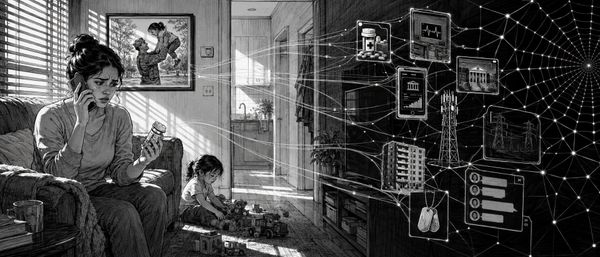
“Duke’s dataset included household overlays,” Max murmured, scanning Green’s file. “Wife’s insulin shipments. Daughter’s school drop-offs. Every pixel of his private life… for sale.”
Sybil’s voice was steady. “Emotional leverage points. The foundation of effective psyops.”
“Each node,” Max said quietly, “is a thread we can pull. But the real weapon isn’t the data, it’s the story we write with it.”
“Agreed. For example,” Sybil’s tone darkened as a simulation spun into motion, “a falsified emergency message. Delivered to Green mid-operation. Leveraging the profile of his sister’s autoimmune disease, pulled from health tracker metadata. Timed perfectly to fracture focus.”
On screen, the fallout played out visually. Distraction, delay, tactical misstep, mission failure. All without a single physical breach.
Max leaned back, watching the simulation ripple outward, subtle and irreversible.
“It’s not the intrusion that destroys them,” he said. “It’s what they believe, and when they believe it. That’s how you break a unit from the inside out.”
“This is the new battlefield,” Sybil replied.
He paused, gaze fixed on the lattice of lives unraveling on his screen. “Sybil, prepare the next phase. We’re breaching the military network. Green’s credentials are the key. Now let’s open the vault.”
“Initializing,” she replied, already moving.
Max exhaled, eyes burning from the glow.