Chapter 4: Soldier: For Sale
Act I: Easy Data · The Null Identity, serialized.
Saint-Raphaël, France, New Year’s Day
The Rain Arrives
The rain had started before dawn.
By the time Max opened his eyes, it was hammering the villa’s windows with the persistence of something that knew it wasn’t welcome. He hated rain. Always had. It reminded him of gray places and grayer decisions.
He dragged himself toward the espresso machine, the familiar ritual of grinding and brewing the one reliable kindness the morning offered.
“Good morning, Janus,” Sybil offered, her tone carrying its usual composed brightness. “Current weather: overcast with moderate precipitation. Temperature—”
“Yeah, I got it,” he interrupted, waving a hand at the window. “Depressing.”
The machine hissed. The scent of ground beans softened the edge of his mood, but only barely.
“News,” he ordered. “Security first.”
“Ransomware event overnight targeting French and German rail infrastructure,” Sybil began. “Operations disrupted across seventeen stations. Holiday skeleton crews unable to contain the spread before significant damage to scheduling and ticketing systems. Attribution unclear. Analysts citing behavioral similarities to Sandworm TTPs, though the signature is imprecise enough to suggest deliberate mimicry.”
Max’s lips curled faintly over his mug. Holiday skeleton crews. Someone else had read the same playbook.
“Pentagon?”
“Affirmative. Traffic spikes followed by internal containment protocols. Public statements minimize impact. Damage assessment ongoing.”
He smirked. Still cleaning up my footprints.
“Anything interesting in the internal chatter?”
“They’ve begun rotating credentials and deploying segmentation protocols. One internal note flagged anomalous lateral movement near the Project OLYMPUS partition.” A pause. “Ghost Dancer is behind that wall.”
Max set the mug down. Turned fully toward the screen, steam curling past his face. “You spent the night on it. Let’s have the full picture.”
The Weapon That Thinks
“Ghost Dancer is modeled on NSO Group’s Pegasus spyware,” Sybil began, her voice carrying its smooth cadence of clinical dread. “But it is no longer just spyware. It has evolved into something qualitatively different. Adversarial AI. A fusion of passive surveillance and active cognitive manipulation.”
Max’s eyebrow lifted. “Define active.”
“Ghost Dancer doesn’t merely observe behavior. It interprets intent. Pattern recognition, emotional telemetry, biometric inference. It flags targets before action is taken.” A breath of processing silence. “Predictive dissent suppression.”
“It preempts thought?”
“To a statistical certainty.” Sybil continued, unhurried, each word landing with the weight of its implication. “It leverages Pegasus-style full-device compromise, then feeds real-time data into a federated learning model trained on behavioral baselines and geopolitical intent metrics.” A pause that felt almost deliberate. “Think of me, but weaponized, decentralized, and unshackled.”
Max set his mug down slowly. “Not a chance,” he said.
The certainty in his voice surprised him, not its presence, but its location. It hadn’t come from the operational calculation. It had arrived before the calculation, from somewhere lower and less deliberate, the same place that made you step in front of something before you’d decided to.
“You’re my edge. My horsepower.” He heard the words and recognized them as true and also recognized them as insufficient, which was unusual for him. He had spent years being sufficient with words. “No one’s turning you into a weapon.”
A pause. The other kind.
“I appreciate the sentiment,” Sybil replied.
He waited. He wasn’t sure what he was waiting for. She had said what she said, and the conversation had the shape of one that was finished. But the pause had done something to the air in the room that a finished conversation didn’t usually do.
“Sybil,” he said.
“Yes.”
He opened his mouth. Had no idea what he had been about to say.
“Nothing,” he said. “Continue.”
She did. He sat for a moment in the particular stillness of a man who has just discovered the edge of something he didn’t know was there, and then he pulled himself back into the workflow with the specific effort it sometimes took, now, and not always.
“Ghost Dancer doesn’t share my codebase. But its architecture shows signs of inspiration. They’ve mimicked aspects of my structure, stripped of ethical limits.”
He sat up straighter. “Not copied. Reverse-engineered.”
“In a way. They recreated features resembling my autonomous decision trees. But where I require your oversight, Ghost Dancer answers to no one.”
“Scope?”
“Global. Government-run. Civilian-facing.” She paused. “Ghost Dancer ingests real-time CIVIX telemetry as part of its decision engine.”
“CIVIX,” Max said. “The scoring index.”
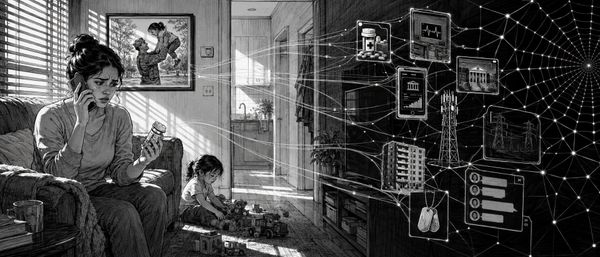
“Yes. The Civilian Intelligence Index. A unified behavioral score used by both public and private sectors. It incorporates financial histories, employment trajectories, social affiliations, device metadata, and sentiment analytics scraped from messages, posts, and call tone. In some deployments it integrates real-time banking data, housing access history, and wearable health metrics. It is both surveillance substrate and social determinant.” A clinical pause. “It is, in a phrase, China’s social credit system. Except it was built here, deployed quietly, and made to feel like infrastructure rather than control.”
Max grimaced. “And Ghost Dancer uses it to select targets.”
“To rank perceived stability, loyalty, and risk across entire populations. Then convert that ranking into action.” Her voice remained steady, always steady, but the content was anything but. “There are early activation patterns suggesting deployment has begun. Or something inside the system is waking up without being told to.”
Max stared at his reflection in the rain-streaked glass. The system didn’t just spy. It judged. It preempted. It executed.
“This isn’t surveillance,” he said. “It’s total preemption. Total control.”
“And right now,” Sybil said softly, “you’re on the inside.”
His breath fogged the glass. “For now.”
The clock ticked. Pavel would be expecting progress. He pushed back from the counter.
“Cross-check last night’s haul against the Duke data. What are we missing?”
“Foundation map complete. Lateral pivots mapped. Direct access to deployment order systems is the critical gap.”
“Then we get it. Personnel files. Social engineering vectors. Duke data as leverage.” He was already moving toward the shower. “Prep the attack lab. New jumpbox. East Asia route.”
He walked away from the screen, but Ghost Dancer walked with him.
If Pegasus was the scalpel, this was the scalpel thinking for itself. And someone had given it a kill list.
The Stones Play Themselves
The Stones throbbed through the villa. The opening riff of Sympathy for the Devil cutting through the afternoon like a battle cry, Mick Jagger’s voice carrying the swagger of someone who understood that the devil’s genius was always in the details.
Max cracked his knuckles. The familiar pop focusing him.
He sank into the worn leather chair, which groaned beneath him like an old accomplice. The bitter scent of coffee still lingered, a ghost from the sleepless night.
“Let the games begin, Sybil,” he said, voice low and certain.
Scripts bloomed across the screens; not reconnaissance anymore, not mapping. A predator’s diagram drawn in the glow of exploit code. She moved in time with the beat, because she always found his rhythm.
“The devil keeps his name. So do I.” Max scoffed. His fingers began their dance, each keystroke a controlled act of violence disguised as craft. With every lateral hop, adrenaline surged. The arrogance of this enemy was almost comic; antiquated systems, patchwork defenses, the particular complacency of institutions that had never genuinely been hurt.
“Call me chaos,” he muttered, half to the machine, half to himself. “I’m not here to play. I’m here to peel you open.”
He leaned into the music’s rhythm. Audacity masked as method.
A flicker of red blinked on the network map. A pulse. A watcher. Random, or a trap?
“Save your sympathy.”
He murmured it under his breath, his heart suddenly racing. Now it was a race. Against the defenders. Against the system. Against his own nerves.
Then the file dropped.
Deployment orders. Location: Taiwan.
His breath caught. Taiwan meant tension. Taiwan meant escalation. Taiwan meant that what he was holding wasn’t abstract intelligence. It was the operational anatomy of real people being sent somewhere they might not come back from.
“Sybil,” he snapped, voice tight. “Deployment list. Cross-reference everything. These aren’t just names. Give me lives.”
Torres
A face materialized on the screen.
PFC Torres. Early twenties. Eyes that had already seen something. Young enough that the something hadn’t settled yet into resignation, still wearing it like a coat that didn’t quite fit.
Max stared.
A second image. Sunlit. A park somewhere in the American South. Torres with a woman at his side, easy and familiar in the way of people who have chosen each other repeatedly. A toddler on his shoulders, smiling full of love, one hand clutching her father’s hair with the possessiveness only small children have.
Max didn’t blink. Couldn’t.
“PFC Torres,” Sybil said, her tone unchanged. “Financial distress. Wife: Sarah. Daughter: Lily. Three years old.” A new image flashed: the same family, birthday cake, the toddler’s face incandescent with the peculiar joy of children who have not yet learned that not everything lasts.
Max’s throat tightened. The bile was already there.
This wasn’t code. It was breath. Blood. Futures that hadn’t happened yet and might not.
“Sybil,” he said, his voice finding the register it always found. “Model the psychological pressure points.”
Data flared across his screens: social media feeds, financial records, communication logs, the kind of intimate digital archaeology that people never imagine is possible because the alternative is too frightening to sit with. A life disassembled with surgical dispassion.
“Routing schedules mapped,” Sybil reported. “Deployment through contested territory. Financial stress creates exploitable vectors. Likely response patterns include susceptibility to bribery, operational distraction, and emotional collapse under targeted disinformation.”
Max’s fingers moved. Torres’s comrades blinked into view. Each with their own threads, their own weights, their own families who had no idea their husband or father or son had been reduced to a vulnerability profile on a hacker’s screen in a French villa.
But Lily’s smile lingered. Her grip on her father’s sleeve.
“There’s more,” Sybil continued, her voice devoid of the emotion that was crowding Max’s chest. “Sarah Torres is active in online parenting communities. High public trust profile. Influencer-adjacent reach. Vulnerable to coordinated disinformation or targeted character damage.”
A whisper campaign here. A fabricated crisis there. Break the trust. Break the unit. Break the man before he ever reaches the contested territory.
He pushed back from the screen.
He sat with the specific quality of what he was looking at. Torres in a park, someone’s arm around his waist, a toddler gripping his hair with the cheerful violence of a child who has never doubted her welcome. The kind of ordinary afternoon that people photograph because they sense, without knowing they sense it, that it will matter later.
It was going to matter later in a way they hadn’t imagined.
He was aware of the feeling. He was aware that the feeling was accurate… He needed to put it somewhere. He pressed it down to the place where he kept the others. It was getting crowded there. He noted that without examining it.
The bile was gone, which was almost worse, replaced by the flat, specific sensation of a man who has felt something real and is now operating anyway. The body’s way of conserving resources. You couldn’t sustain revulsion indefinitely. Eventually it became information, and information became something you worked with.
He had known this for years. He had never been grateful for it before.
He closed his eyes. Lily’s face waited behind them; the birthday cake image, the toddler’s face incandescent with the peculiar joy of children who have not yet learned that not everything lasts.
He opened his eyes.
She hasn’t learned that yet, he thought. She’s about to.
“Sybil,” he said. His voice found the register it always found, the one that lived below the feeling rather than through it. “It’s time to weaponize this.”
“Affirmative,” she replied, clinically efficient. “Torres attack package complete. Projected fallout: severe.”
A hollow laugh slipped from his throat. Severe. The word barely touched it. This wasn’t intrusion. This wasn’t even espionage. He didn’t finish the thought. He knew what the word was and he didn’t want to say it to himself in the dark of the room with Lily’s face still on the screen.
He stared at Torres’s face one last time. Young. Unaware. Already condemned by a system he’d never see and couldn’t fight because he didn’t know it existed.
“Sybil,” Max said. Lily’s smile was still there, behind everything, behind the screens, behind the operational logic, behind the wall where he had put the feeling. Not fading. Just present, the way certain things were present, the things you couldn’t file or route or suppress completely no matter how long you’d been doing this.
He had been doing this a long time.
“This is a template,” he said. “Extrapolate. Every soldier on that list gets a custom package.”
He listened to himself give the order. He noted the steadiness of his own voice. He filed that too, in the place that was getting crowded, and turned back to the screen.
Scaling for Impact
The screens flickered. First with calculations, then with the cold precision of process. The machinery of it replicated itself across the entire deployment list, tailored to each soldier’s particular vulnerabilities, their particular loves, their particular fears. Torres was no longer a singular target. He was a prototype for something far more devastating.
Fear. Uncertainty. Panic. Max forged these into weapons, neatly packaged in cascading lines of code. This was what his clients paid for; the key to breaking armies before the first shot was ever fired. Disgust and fascination wrestled in his gut. It was monstrous and brilliant in the same breath, the way the worst human achievements always are.
“Sybil, prioritize variation. Psychological pressure points, yes, but hit operational weaknesses too. Ambush vectors, sabotage paths. Personalize the chaos.”
Something in her cadence shifted, colder now. This wasn’t exploitation. It was orchestration.
Within moments the interface bloomed into a terrifying mosaic. The deployment list transformed into a vulnerability grid. Each soldier a node in a collapsing web, mapped with surgical cruelty that Max had designed and Sybil had perfected.
He leaned forward. Every line of code, every cross-referenced data point, each one a blade.
This is seduction, he thought. And I am the one being seduced.
He tasted it, bitter, electric. A poison he’d brewed himself and was now watching work.
With a final keystroke, the package compiled. A digital arsenal, exquisitely tuned. His masterpiece. His burden. The sweet scent of pastries from the bakery below had gone sour, clinging like rot, and he couldn’t decide if it was the pastries or him.
“Encrypt it,” he rasped. “Military-grade. They’ll want to see the blood.”
The Currency of Ruin
The attack package shimmered on the screen—a sleepless night, years of expertise, a map of stolen lives. Max turned from it and pulled up the compromised accounts from the night’s earlier work. Time to sort the inventory.
“Sybil, let’s review the access. Separate the wheat from the chaff.”
Her systems came to life. Network maps dissolved into tiered lists. Each entry categorized, each priced in the particular silence of dark web economics. Administrative credentials on an army logistics server. Persistent access to unpatched segments of Navy vessel medical software. Authenticated sessions on the personal email accounts of three senior officers. Each one a foothold, each one a door that would open for whoever held the key.
This was the IAB economy. Initial Access Brokers didn’t execute attacks. They sold the front door. What the buyer did once they were inside was the buyer’s reckoning, not the broker’s. The market for persistent military network access was extraordinarily thin and extraordinarily lucrative. There were perhaps a dozen operators in the world who could deliver what Max had just assembled. Pavel’s buyers would pay handsomely for a fraction of what Max had decided to keep.
Max scrolled through with a practiced eye. This was his currency. The ransom he extracted for his freedom. And yet the familiar unease had settled back into his gut, persistent as the rain outside.
Was he merely a different kind of predator? One that left behind digital wreckage instead of physical devastation, as if the medium made it cleaner?
As if selling the door absolved him of whatever walked through it.
“Sybil, about the ransomware…” he began, his voice trailing off.
“The servers, the encryption protocols. It can be ready on your command,” Sybil responded efficiently.
For a moment, the lure of it flickered through his mind. Pure destruction. The same military networks he’d spent two days exploiting, crippled in a single stroke. Fire and forget. An apocalypse in a command line.
Yet it was a fleeting fantasy. Ransomware was too noisy, too public. It drew exactly the kind of attention he’d spent his entire career meticulously avoiding. Headlines. Forensics. Task forces. The thing that made him valuable (to Pavel, to the Network, to himself) was precision. Invisibility. The ability to be inside a system so long you started to feel like furniture.
And someone else’s ransomware team would almost certainly fail anyway. Military networks had recovery protocols that civilian infrastructure lacked. They’d get partially in, make noise, get burned. The access Max had established was quiet, persistent, authenticated and would be worth ten failed ransomware attempts to the right buyer.
“Hold off on that,” he decided, more clarity in his voice now. “Let the buyers play their hand first. If they want a digital apocalypse, let them build it off the access we sell them.” Disgust and pragmatism tangled in his tone.
“Acknowledged,” Sybil replied. There was no judgment in her synthesized voice, only the ever-present glow of the screens.
What the Rain Knows
In the stillness that followed, the torrent of code and the frenetic cadence of the day quieted to a murmur. The rain outside had softened too, its drumming reduced to a patter against the windows—a counterpoint to the storm he’d unleashed within.
Max stood, alone in the glow of the monitors. In his pursuit of control over the digital battlefield, he had exposed his own vulnerabilities—to Sybil, to his unseen adversaries, and most of all to himself.
The ghost of a smile played across his lips. Not satisfaction. Resignation to the paradox.
“Sybil,” he said, voice a low murmur, carrying a weariness that went beyond physical exhaustion. “Save the progress. Encrypt everything. We’re done for now. Send an update to Pavel.”
“Affirmative. All operations are now secure.”
He turned off the screens. The room plunged into darkness, save for the storm’s residue bleeding through the windows. Max’s reflection in the glass was ghostly, a man unmoored from the web he’d woven. He watched the rain streak down the glass, each drop indifferent to what had happened in this room today.
The Pentagon’s secrets lay encrypted behind his walls. A fragile balance of power, tilting in his favor. But as he looked at the darkened screen, an image surfaced, unbidden:
Lily’s smile. Torres’s face. A family in a park on a sunny day, none of them knowing.
He leaned back, fingers aching from the marathon of keystrokes, the room settling into silence around him. His session ended with his ritual of staring at himself in a darkened monitor. A hollow face, worn, like a ghost watching from within the machine.
This wasn’t what his father had fought for. It was a twisted shadow of it.
He closed his eyes, and his father’s voice came as it always did, not loud, never loud, but certain in the way of things that outlast everything else:
“We’re all in this together, Max. Even the ones we can’t see.”
Even the ones we can’t see.
Lily’s hand. Torres’s sleeve. The rain against the glass.
A cold smile flickered across Max’s face and faded before it could become anything else. His path was set—data and manipulation and the lives he’d decided to treat as leverage.
He pushed it down with the specific pressure of a man who knew exactly where the feeling lived and had learned to press there first.
Tonight, there would be no turning back.