Chapter 6: Collateral Souls
Act I: Easy Data · The Null Identity, serialized.
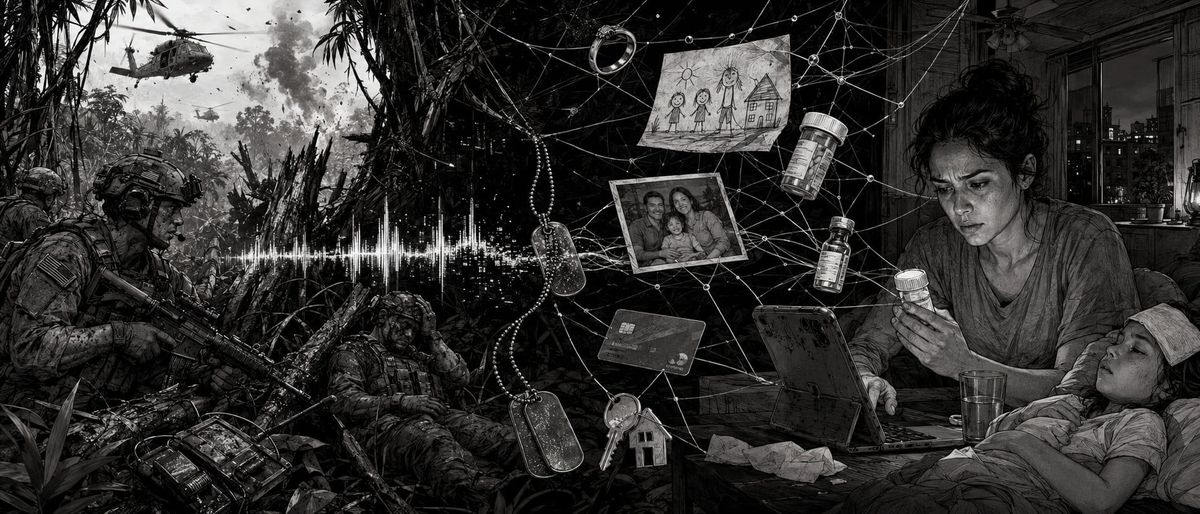
Somewhere in the jungle. January
Battlefield Chaos
Sergeant Niemi’s instincts screamed as the world erupted around him.
Explosions cracked the thick jungle air, scattering debris and plunging the reconnaissance mission into sheer turmoil. Gunfire rattled relentlessly, slicing through branches, turning their surroundings into a nightmarish blur of smoke, flickering shadows, and the pungent stench of burning vegetation.
Niemi flattened himself against a shattered tree trunk, the remnants of its charred bark falling away under the assault. His breathing was labored, the humid air mingling with the metallic tang of blood. A visceral reminder of the wound in his arm. Glancing down, he saw his sleeve darkening, the stain spreading with a vividness that clarified everything.
Through the haze, he spotted Corporal Bahm, eyes wide with an urgency that mirrored his own. Bahm yelled something, but the sounds were swallowed by chaos. The fractured comms buzzed faintly, carrying snippets of frantic voices drowned in static (disjointed orders, panicked cries) each one adding to the disorientation rather than cutting through it.
Then Bahm’s voice broke through. “They’re one step ahead of us, Sarge. It’s like they know every move we make.”
The words hit Niemi like a cold slap. Intelligence had warned of a data breach before deployment. Abstract language about exposed profiles, the possibility that personal information had been compromised. He had filed it alongside a dozen other pre-deployment briefings that were meant to inform rather than alarm. Now, crouched behind a burning tree in a jungle that felt impossibly coordinated against them, he could feel the weight of that exposure pressing down with physical force. Their home addresses. Their families. Their routines and fears and private histories; all of it translated into tactical advantage for an enemy who shouldn’t have known their names.
He gritted his teeth, scanning the dense canopy for movement. A mortar whistled through the air, its arc unmistakable. One second. “Down!” He shoved Bahm flat as the ground convulsed from the impact, shrapnel raining in an unforgiving hail. As the dust settled, Niemi’s ears rang. Through the ringing, something wrong threaded itself into his awareness. Laughter, cutting through the trees, deliberate and mocking, from somewhere that wasn’t close enough to be a combatant.
Bahm crawled closer, face streaked with grime and sweat, eyes flickering. “Comms are down. We’re on our own out here.”
The weight of it settled into Niemi’s chest. They weren’t just facing a well-trained enemy. They were up against something that had seeped into their lives long before this jungle. Through their own data, through the digital footprints of their families, turning the most human parts of their existence into weapons deployed against them with clinical efficiency.
Bahm had picked up a strange frequency crackling over his radio, not allied forces, not standard military band. Low and distorted, the transmission carried through intermittent static, but a few words were unmistakable:
“You thought you could hide… predictable… every step.”
As the voice faded into static, a new kind of silence settled over Niemi. The kind that told him they were far deeper than any of the briefings had prepared them for.
Attack on the Homefront
Sarah’s fingers moved across her phone screen for what felt like the hundredth time, refreshing the message thread that refused to update.
Still nothing from Torres.
Two days ago, a brief check-in before the mission. One of those I’ll call when I can messages that tried to sound casual and always landed heavy. Since then: silence of the kind that had texture, that pressed against her in the small hours of the morning and followed her through the day.
She glanced at the clock, mentally counting the hours. He would usually find a way. Even a single line. The absence of even that felt like a specific kind of wrong.
She checked her phone again. And stopped.
An unfamiliar number. A message, its tone carrying a casual familiarity that made her skin prickle before she’d finished reading it.
“We know you miss him. Don’t worry, he’s right where we want him.”
Her breath caught. She held the phone very still, staring at the words. Spam, maybe. A wrong number, a sick joke, the random cruelty of the internet landing in her thread by accident. She started to delete it.
Then stopped.
The phrasing was too specific. Too calibrated to the exact fear she’d been carrying for two days.
As she stared at the message, a notification from her banking app appeared. A charge of $4.04 from Not Found Café. Her stomach dropped.
A charge she didn’t recognize. An unauthorized withdrawal from a café she never visited.
Her fingers trembled slightly as she scrolled through the transactions, finding nothing else unusual, which made it worse somehow. One deliberate strike rather than the chaos of a broad breach.
She pushed back the rising panic and switched to social media. Looking for something familiar, something anchored.
A tagged post caught her eye. She froze.
A connection she didn’t recognize had posted about Torres’s deployment. Not vaguely. Specifically. Details she hadn’t shared publicly. Details he hadn’t even shared with her in full. Her skin prickled, her heart found a different rhythm. The world felt sharper suddenly, every notification a potential threat, every shadow in the room meaningful in a way it hadn’t been an hour ago.
She called Emma.
The line barely rang once.
“Sarah?” Emma’s voice was already shaky, already wound tight. “Have you been having… weird things happen? Texts. Things you can’t explain.”
The fear in Sarah’s chest tightened into something colder. “Yes. There was a withdrawal I didn’t make. And a message. Someone saying he was where they wanted him.”
Emma let out a breath that was barely steady. “Someone posted about Niemi’s deployment on my account. Said I should ‘cherish the memories.’ And then our joint account flagged fraud warnings an hour later. It’s like they know everything, Sarah. Not just the public stuff. Everything.”
The line went quiet. Both of them understanding simultaneously.
This wasn’t random. They were being watched, tracked by something that had their lives mapped with a specificity that went far beyond what they’d knowingly made public. Someone had built profiles of them from the accumulated data of their daily existence and was now using those profiles against their families with the precision of a surgical strike.
“This can’t be a coincidence,” Sarah said, her voice lower now. “Emma, I think we’re all being targeted. All of us. They’re using everything they know about us.”
“But why?” Emma’s voice was close to breaking. “Why us? And how do they know?”
Sarah didn’t have the answer yet. But the questions settled into her like ballast, not paralyzing her, but weighting her toward something. A direction. A fight she hadn’t chosen but was already in.
She stared at her darkened phone, feeling the edges of her world contracting with each new piece of evidence. Then she straightened.
She had told her husband about Lily. And that was still true. For the moment, she was still functional, still connected, still able to act. Whatever this was, she wasn’t going to wait for it to finish arriving.
Battlefield Psyops
Bahm crouched low in the undergrowth, senses razor-sharp, scanning.
The firefight had eased momentarily. That particular quality of silence that wasn’t safe but was a pause, a held breath before the next exhalation of violence. Their squad was fractured, scattered through the dense jungle, each man isolated in his own pocket of fear. His pulse hammered. His grip on the rifle was too tight and he couldn’t make himself loosen it.
Then his comm unit crackled to life.
Not with orders. Not with coordinates or callsigns or any of the sounds that belonged in his ear.
“You should’ve stayed home,” a voice whispered. The tone was wrong in a way that took him a full second to process.
He froze.
A glance at his comms confirmed the transmission was real. This wasn’t hallucination. This wasn’t the jungle playing tricks on a mind stretched past its limits.
More voices followed. Broken, distorted, filtering through the static from multiple channels. One by one, his teammates went quiet, not the focused silence of men holding position, but the stunned silence of men hearing something that shouldn’t be possible.
Snippets of wives. Children. Fragments of voices they hadn’t heard in weeks, carrying fear and desperation and the particular anguish of people who didn’t know they were being used as weapons.
And then his mother’s voice, unmistakable even through the distortion.
“PJ… you’re in danger. Come home. Please, just come home.”
His childhood nickname. The one she’d called him before he grew tall enough that it embarrassed him. The one he had never posted online, never mentioned in any public context, the one that lived only in his family’s private vocabulary.
His throat tightened. The plea sounded so close, so real. The exact quality of her fear when she was trying not to show him she was frightened. A part of him, some deep animal part that predated training and discipline and thirteen years of service, wanted to believe it. Wanted to turn back, to run.
But beneath that part, something colder understood. They had found the nickname. They had found the specific frequency of his mother’s voice, the particular words that would reach past every defense he’d built, and fashioned it into ammunition.
This was the data. This was what the breach meant. Not identity theft in the bureaucratic sense. Not credit card numbers and social security digits, but the intimate architecture of a life. The things you never thought to protect because you never imagined they could be used against you.
He caught Sergeant Niemi’s eye across the undergrowth. Neither of them spoke. They didn’t need to. They were both holding the same knowledge. This wasn’t a battle they could fight with the weapons they’d trained on. The enemy had gone around every physical defense and reached straight into their most human vulnerabilities.
A soldier staggered toward them, eyes wide with a raw and unguarded fear. “Sarge… my wife just told me… she says they’re watching us. Said if I don’t come home, they’ll…” His voice broke. He shook his head as if trying to physically dislodge the message.
Bahm’s jaw clenched. A simmering anger cut through his own fear and he let it, anger was cleaner than despair, more useful than the alternative. He forced himself to breathe, to push back against the invisible strings.
They had to stay on the line. Even when everything human in them screamed otherwise.
Especially then.
The Puppeteer
The room was bathed in a dim, sickly glow, the kind that barely revealed faces, that made the people within it look like projections rather than persons. The air thrummed with a cold, sterile hum punctuated by the steady rhythmic clicks of keyboards. Each screen pulsed with real-time data: troop locations, fragmented voice transmissions, social media profiles cross-referenced against financial records and medical histories.
At the center stood Koval.
The leader of this operation was not what the word “leader” usually conjured. No raised voice, no demonstration of physical presence, no performance of authority. Koval led through the particular economy of someone who has never needed to announce themselves because the room already knew. A silhouette sharp against the pale blue glow, observing the chaos they had wrought with the quiet satisfaction of a craftsman checking work that has come out exactly as planned.
Koval’s fingers moved against the console in a rhythm (four beats, pause, three beats) a private metronome that only emerged when things were going well. The people in this room had learned to recognize it.
“Reports from the field indicate significant disorientation,” an underling reported, tapping a tablet. “We’re seeing hesitation among key operatives. Breaks in unit cohesion. It’s only a matter of time before—”
“It was always only a matter of time,” Koval replied. “That was the design.” A flick of the hand, casual as adjusting a lamp. “Increase the frequency of deepfake messages. Multiple family members per target. Find what breaks each one fastest and use that.”
New feeds populated the screens. The soldiers’ profiles were displayed with the organizational precision of an operations room. Every layer of their lives that had been made available through purchase, breach, and inference. Koval’s gaze moved across them the way a surgeon’s eyes move across a body opened on a table. Not with cruelty. With function.
An underling approached. “We’ve achieved high destabilization metrics in under three hours. The network for the entire region is primed for disruption. Initiate the next phase?”
Koval didn’t hesitate. “Yes.” A pause, allowing the word to settle before the elaboration. “Inform our benefactors that the success here establishes clear precedent. This is Taiwan at proof-of-concept scale. What we are doing to a single reconnaissance unit today, we will do to entire forward commands tomorrow.” The fingers resumed their rhythm. Four beats, pause, three beats. “Today, a controlled test. Tomorrow, geopolitical recalibration.”
The word Taiwan moved through the room like a current. The operatives exchanged a glance. The shared understanding of people who are building something with implications they have chosen not to fully examine.
Koval turned back to the screens and narrowed on a specific profile. Sarah Torres. Her activity had shifted in the last hour. The desperate, scattershot quality of someone who had begun to realize what was happening to them and was reaching out in every direction at once. Her posts, once personal and unremarkable, had become cries into the digital void. And she was connecting with others. The network of spouses was beginning to thread together.
“Begin Phase Two,” Koval ordered, voice low and precise. “Redirect the bank alerts. Flood her social media with tailored disinformation. Show her she is not just alone but powerless. Demonstrate to her that her own voice has been taken from her.” A pause. “Break them perfectly.”
The fingers tapped. Four beats, pause, three beats.
“Sir, the Torres profile is prepped for escalation.”
“Good,” Koval replied. “Let her feel the weight of it. Every action she takes will tighten the net further. This is what we teach tonight; that reaching out makes you smaller, not larger. That the instinct to connect is a vulnerability we have already mapped and prepared for.”
The cold smile lingered, then receded. Not into warmth, but into the focused neutrality of a professional returning to work.
The Sounds of Silence
Sarah’s hands trembled as she scrolled through her notifications, each one worse than the last.
Her bank app returned a locked icon, flashing ominously, her repeated attempts to access her accounts refused with a message she had never seen before. Cold and final: Account Suspended. Contact Customer Support. She tried three times. The same response.
She switched to her social media feed, looking for the familiar; the school updates and recipe swaps of the military spouse group, something grounding, something that belonged to her life.
Her profile was flooded.
Strange posts tagged with her name. Some mocked her. Others carried her username attached to rants she had never written. Bizarre diatribes about military operations, conspiracy theories about the government, the kind of unhinged content that would make anyone who saw it reach for a diagnostic rather than a phone call. Comments from strangers she had never encountered filled her feed, their reactions ranging from performative sympathy to gleeful cruelty.
A message from her mother: “Sarah, honey, are you okay? You’re all over the place. Call me.”
Sarah’s face flushed, not with shame, but with the particular anger of someone who has just understood the full scope of what is being done to them. This was deliberate. This was the operation extending itself into her reputation, her relationships, her credibility. Building the narrative that would neutralize her before she could speak loudly enough to be heard.
She put the anger somewhere useful and began reaching out to the other spouses. Her fingers moving fast across her phone, piecing together a list, sending messages, waiting.
The replies came quickly, and each one was a confirmation of what she had already begun to understand.
“My bank account’s been acting up all day.”
“Calls from random numbers. People saying they knew where my husband was.”
“They’ve been tagging my social media, saying I’m losing it.”
“There’s a post on my feed saying I’m filing for divorce. I didn’t write that.”
“I got a message saying my husband was MIA. He’s not. I think.”
Sarah read through each response, the pattern clicking into place with terrible clarity. This wasn’t phishing. This wasn’t the broad, indiscriminate spray of a standard cybercriminal. This was targeted, specific, and coordinated. A deliberate operation against the families of a single unit, using the intimate details of their lives as the mechanism of destruction. Bank accounts. Social media. Personal relationships. Medical records. The architecture of daily existence weaponized against the people who had never imagined it could be used this way.
Her jaw set.
She scrolled through her contacts until she found a name she hadn’t called in years. Senator Thompson. A handshake at a Gold Star family event. A business card she had kept because she couldn’t bring herself to throw away the gesture it represented.
She stared at the number. Then hit dial.
Battlefield Desperation
The chopper touched down hard, rotor wash kicking up thick clouds of dust and leaves as Torres and his team scrambled clear. The roar faded, leaving an unnatural silence that had the specific weight of a trap waiting to close.
They spread out. The eerie quiet shattered with a single calculated shot.
The crack of gunfire echoed through the trees, and one of the soldiers staggered, clutching his shoulder as he went down into the underbrush. Torres dropped low, rifle tight against his chest as the jungle erupted. Bursts of fire cutting through the dense foliage with a precision that told him everything he needed to know about who was waiting for them.
They had been anticipated. Every angle of retreat was covered. Every attempt to regroup was thwarted before it formed. The enemy wasn’t attacking, they were herding, picking off the unit with the unhurried confidence of people who already knew how it ended.
“Fall back!” he shouted, knowing even as he said it that retreat was exactly what had been planned for.
Two more men went down. The jungle had been prepared for them. Their movements, their protocols, their contingency routes, all of it already known, already defended against.
Between the chaos and the discipline his body maintained on instinct, Torres’s mind kept returning to the reports from earlier. The voices through the comms. The deepfake messages in his teammates’ ears. Someone had taken the data of their lives (their families, their fears, their private histories) and converted it into tactical intelligence. The battlefield they were fighting on was partly digital, and it had been set before they landed.
He crouched behind a fallen tree trunk, heart hammering, scanning.
His hand found his pocket.
The contraband phone. He knew the risk. Every second it was powered on was another opportunity to triangulate his position, to turn the signal of his reaching for Sarah into the signal that got him killed. He knew this. He had told his men not to use their phones.
He powered it on.
Sarah’s messages flooded in. Dozens of them, each one more urgent than the last. The escalating frequency of someone watching a situation deteriorate and unable to reach the person they needed most.
“Are you okay? Please say something.”
“I think they’re watching us. You’re being tracked!!”
He read them in the green-lit dark of the jungle, his grip on the phone tightening with each message. Her fear was in every line. The specific fear of someone who has realized the danger is real and has no way to help the person they love. He could feel the thread of it stretching from here to wherever she was, pulling at something in him that the training didn’t touch.
He took one more second. Found her last message.
“I love you. Be safe.”
Torres stared at the words, committing them to somewhere beneath memory. Then he powered down the phone and pushed it deep into his gear. The silence that replaced her voice settled over him like a weight he chose to carry.
He turned back to the jungle as the enemy appeared. He gripped his rifle. He forced his breathing to steady.
He was going to survive this. Not for the mission. Not for the unit.
For her.
A Call for Action
“Senator Thompson’s office, how may I help you?”
“This is Sarah Torres,” she said, keeping her voice from shaking through an act of will she could feel in her jaw. “My husband is deployed, and something is happening to our families. It’s not random. It’s coordinated. Targeted. We’re being attacked.”
The aide paused. “Mrs. Torres, I can take a message—”
“No.” Clean and firm. “I need you to understand that this is critical. Seven families. Same unit. Unauthorized bank activity, deepfake messages impersonating their loved ones, social media accounts compromised and used to make us look unstable. They’re using us to destabilize our deployed spouses. This is warfare. On domestic soil. Against military families.”
A different kind of silence. Then: “One moment.”
A click. Then a voice. Gravelly, present, carrying the particular quality of someone who has learned to listen to what people are actually saying rather than what they expect to hear.
“This is Senator Thompson.”
Sarah took a breath and gave it to him straight, no hedging, no preamble, the clarity that comes when fear has been converted into something useful. Seven families. Same unit. The specific attacks: bank fraud, deepfake voice messages, coordinated social media manipulation designed to make them appear unstable, isolate them from their support networks, and fracture the unit through the suffering of their families. Not cybercrime. Not harassment. Psyops, weaponized, deployed against American military families on American soil.
The senator didn’t interrupt. When she finished, the silence lasted long enough that she thought the call had dropped.
Then: “You’re not the first call I’ve gotten about something like this. But you’re the first person to speak that clearly about what it actually is.”
“It’s active,” Sarah said. “Whatever DARPA ran in tests, this isn’t a test.”
Another pause. Papers rustling. A pen clicking. Then, with a shift in register that told her he had made a decision: “I’ll contact Cyber Command directly. If even a fraction of what you’re describing is accurate, this isn’t harassment. It’s a coordinated psychological attack on the families of deployed military personnel. That’s an act of war on a domestic front.”
The relief that moved through her was tempered immediately by the knowledge that relief was premature.
“Thank you,” she said. “Please don’t let this get buried.”
“I won’t. And Mrs. Torres, document everything. Every message, every transaction, every post. If they’re trying to erase you, don’t make it easy for them.”
“I won’t,” she said.
Just as she started to respond, the lights in her apartment flickered.
Then went out.
Her phone screen dimmed. The signal icon vanished. She checked, battery nearly full, which meant this wasn’t her phone. She walked to the window.
Her entire street was dark. No streetlamps. No porch lights. The quiet kind of darkness that means infrastructure, not storm.
She held the dead phone in her hand. She looked out at the neighborhood that had been erased from the grid.
She opened a drawer. Found a notebook. Found a pen.
And in the dark, by memory and instinct, she began to write.
Expand the Protocol
Koval watched the screen go dark where Sarah Torres’s profile had been active moments before.
The blackout had taken effect across her area with the quiet precision of a system working exactly as designed. The transmission from her phone flickered twice, then went silent as her connection was severed. Her last action captured before cutoff; a call to a legislative office, flagged, logged, routed for analysis.
Around Koval, the operatives maintained their focus. Movements precise. Unhurried. The particular efficiency of people who have done this enough times to know that panic is a resource expenditure with no return.
“Sir, communications in her area are severed. Any activity will now be contained.”
Koval gave a barely perceptible nod. “Good. Silence will serve her well. We don’t need voices rising where they don’t belong.” The fingers found their rhythm on the console. Four beats, pause, three beats. “She appears to have called a senator’s office.”
“Should we—”
“No.” A pause. “Let it sit. A military spouse calling a senator about what she believes is harassment. By the time anyone with the appropriate clearance takes it seriously, we will have moved to the next phase, and this will read as the paranoid documentation of someone who was already losing credibility.” A thin smile. “We prepared for that too.”
He turned, taking in the wall of screens, each displaying a different family, a different life caught in the web, each one a proof of concept for what came next.
“Expand the protocol,” he said, his voice as calm as a man ordering coffee in a familiar place. “Sarah Torres and her community are the demonstration. The benefactors need to understand what they’re purchasing. Not just the attack capacity, but the invisibility of it. The way it looks, from the outside, exactly like chaos. Like coincidence. Like a breakdown.”
The fingers tapped. The room listened.
“Imagine this on a global scale. A coordinated blackout. One region at a time. Each falling into quiet submission without understanding what has happened to it. No resistance, because resistance requires communication, and we have removed communication. No disruption, because disruption requires organization, and we have atomized the organizations.” A pause. A breath. Something in the room shifted. “Just the certainty that when we turn out the lights, there will be no one left to turn them back on.”
The operatives exchanged a glance with the shared recognition of people who have just been told the full scale of what they are part of.
Koval looked back at the screen where Sarah’s profile sat dim and motionless. A silent digital artifact where a person had been. The fingers tapped their rhythm one more time.
Then Koval signaled the room to power down the feed.
Into Darkness
The darkness closed in like a held breath.
Sarah’s apartment was blanketed in silence so complete she could hear her own heartbeat. Each beat amplifying her isolation, measuring the distance between what she could reach and what had been taken. Her phone serving as her only light. The street outside was equally extinguished. Every streetlamp, every house, every familiar landmark of her neighborhood had fallen into a darkness that had no storm behind it, no innocent explanation.
She moved to the window. Pressed her face against the glass. Searched for any flicker of life.
Nothing.
The walls of her home, once a sanctuary, now felt like the edges of something else. A space where she could be observed and manipulated and reduced by the accumulated weight of every digital thread that had ever connected her to the world being cut simultaneously. For a moment, a cold wave moved through her. Whoever was behind this could reach into her life and strip it of every connection, every piece of normalcy, with the efficiency of a system rather than the effort of a person. The reality of it pressed down with the specific weight of things that are true and terrible.
But deep in the pit of that fear, something sparked.
Not bravado. Not performance. Something quieter and more durable. The particular stubbornness of a person who has been pushed to the edge and discovered that the edge is where they are strongest.
She straightened in the dark room. Her voice, when it came, was barely above a whisper. But it had the quality of something said to the room itself, to the night, to whoever was watching her profile on a screen somewhere and feeling the satisfaction of a blackout achieved.
“They can’t silence us all.”
The words cut through the stillness as a promise to herself, to the families under attack, to everyone who would one day understand what had been done here. Small in the dark. Unrecorded. Unwitnessed except by the walls of her home.
But the walls had heard it.
And she had meant it.
The shadows thickened around her. Sarah held her ground, her gaze steady, the notebook open on the table behind her, the pen still wet with everything she had documented by candlelight before the candle burned down.
They had turned out the lights.
She was still here.