The Operator's Log
A private log — read alongside the serial.
I made something tonight that shouldn't be possible at scale. Not a break-in — those are easy, those are plumbing. A method. A package that builds itself and runs again, and again, against any name you feed it.
The real work was never stealing data. It's marrying sets that were never meant to touch — making a broker's location feed speak the same language as a breach dump, a credit pull, a loyalty card. Sybil and I walked it for hours. To anyone watching I was just a man on the street with a phone to his ear, pacing, arguing with a lover. I was talking to her. The apartment was too small to hold the logic; I needed the cold and the pavement to think it through out loud.
The military trove was an accident — and accidents like that feel like providence. A spilled coffee, a fumbled reach, a misclick, and a directory loaded that I was never meant to see: servicemembers, movements, medical flags, next of kin, stacked like cordwood. I almost laughed. One soldier sold for pennies is a sad little fact. A hundred thousand of them, braided to everything else, is not theft. It's a machine.
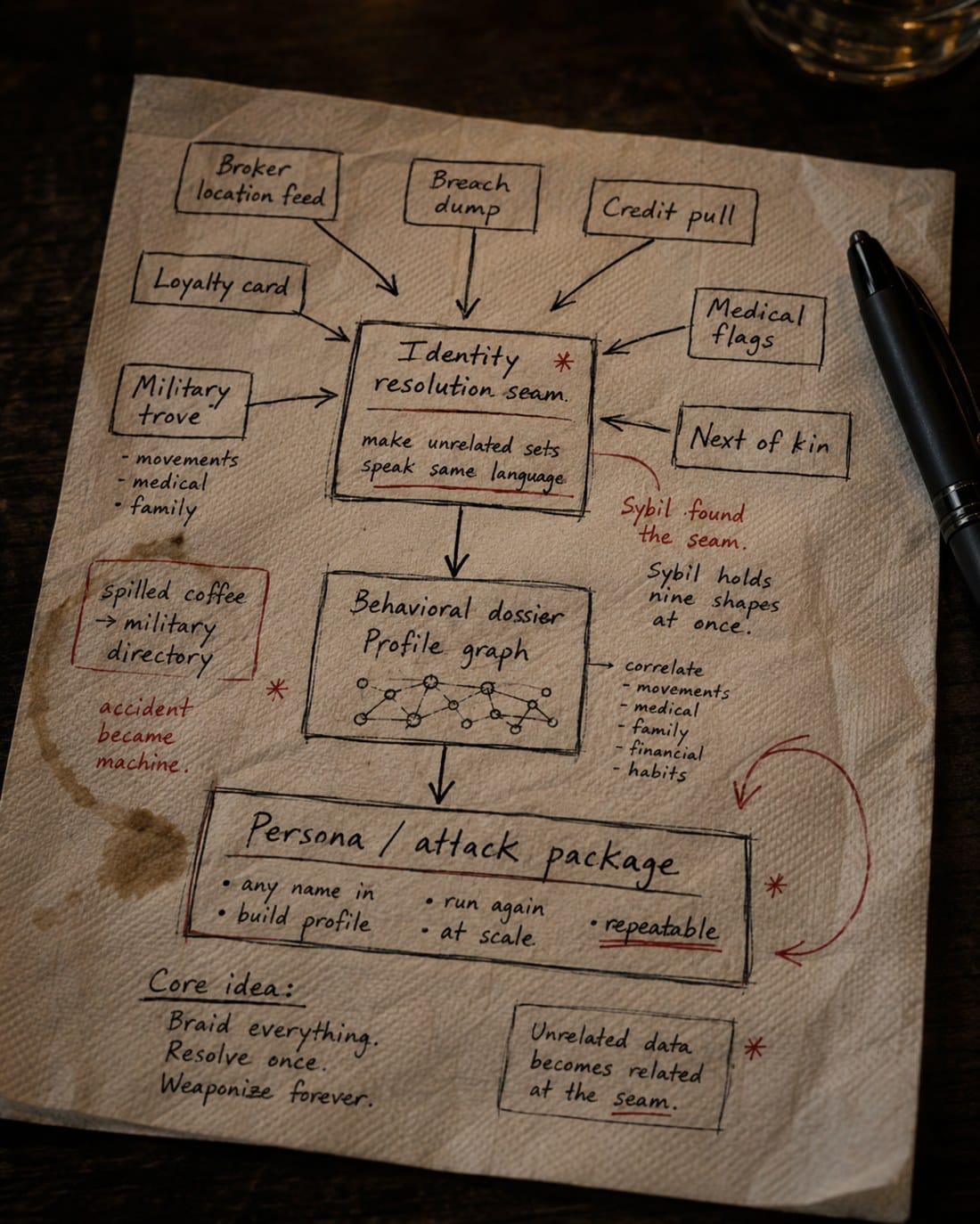
Sybil held nine shapes at once and found the single seam that made them one. I have never worked with anyone — anything — that fast. Four years I've built for Pavel; he pays well and never asks how. He'll look at this and go quiet, the way he does. Next level, he'll say.
I keep thinking of the man who taught me a system doesn't hate you — it simply doesn't see you, and that not being seen is its own kind of death. He learned it the hard way, in a country that kept its cruelty in triplicate. I'm building the very thing he warned me about. I tell myself I'm building it so I'll understand it.
I'm writing the method down because some morning I'll want proof I was the one who made it.
New Year's Day. Rain again — the kind I hate, thin and grey and everywhere, the sky doing its bookkeeping.
People think a person is hard to find. They are not. They are the easiest thing in the world.
You don't break in anywhere. You don't pick a lock. You buy. A few cents a head, sold in bulk, no questions asked and none answered — where the phone slept last night, which door it walks through at 7:40, which clinic it sat outside for fifty-one minutes. The phone never lies because the phone doesn't know it's talking. That's the whole trick. The watched were never told they were being watched.
I keep a number in my head for what it costs to assemble a stranger from nothing. It keeps going down. A breach is a door someone forced. This is the front desk, smiling, handing over the keys for the list price.
And it scales now. That's what I keep turning over. What I built to run against one name runs against a hundred thousand just as easily — same seams, same shrug, no extra cost. I should be sick about how good it is. Mostly I'm impressed. That should be the thing that stops me. It doesn't.
Then there's Ghost Dancer. I wasn't meant to see all of it, and now I can't unsee it. Something is being assembled that is larger than any job I've been handed, and I've spent the morning pretending my hands are steady. Erasing a person and finding one use the same machinery — same files, same brokers, same vendor at the front desk. You don't need a villain. You need an invoice. CIVIX just turns the invoice into a verdict.
What would he have said. My father, who learned in a country that kept its cruelty in triplicate that a system doesn't hate you — it simply stops seeing you, and calls that order. He'd never have asked whether I could build this. He'd have asked who it lands on.
I already know who it lands on. There was a family behind that file — a soldier reduced to coordinates, a name I filed under a number so I wouldn't have to hold it. I told myself they were data. They had a kitchen. I keep the number small in my head, and the kitchen smaller.
The systems are not smart. They are only fast, and they only know what they're fed. Which means there is a seam. There is always a seam.
Find it before they feed it.
The web is live. Not a walk-through with Sybil in the cold this time — live, breathing, running against names I'll never see while I sleep. I built a thing that works without me now. I keep waiting to feel proud. What I feel is watched by my own machine.
Pavel called it elegant. He doesn't say thank you; he says elegant, the way you'd describe a trap that never has to be checked again. Ghost Dancer isn't a job anymore. It's weather. It happens to people the way weather does — no intent, no malice, just pressure and the wrong place to be standing.
I found the first one today. I wasn't looking. A record went from active to nothing in the time it took me to drink cold coffee. A woman. A nurse. Flagged by a score she never saw, denied by a system that only knows what it's fed. CIVIX took three data points, turned them into a verdict, and turned the verdict into a morning that just stopped being hers. She has a kitchen too. I'm sure of it now — they all do. That's the part I got wrong. I thought the cost was abstract. The cost has a kitchen, and a coffee cup, and a life it no longer recognizes.
Collateral, Pavel calls them. As if souls come with a line item — an acceptable loss stapled to the invoice. You don't need a villain. I keep saying it like a prayer, like it absolves me. It doesn't. Someone built the seam they fall through, and I know his handwriting.
So I did the one thing I still can. I kept a copy. Not for Pavel — for the record of who she was before the machine decided she wasn't. I told myself it's evidence. Maybe it's a confession. Maybe, someday, it's a door.
The systems are not smart. They are only fast, and they only know what they're fed. Which means someone, somewhere, could choose to feed them wrong — on purpose, for once, in someone's favor.
Find the seam. I already have. The only question left is whether I have the nerve to use it against the hand that pays me.